-
69
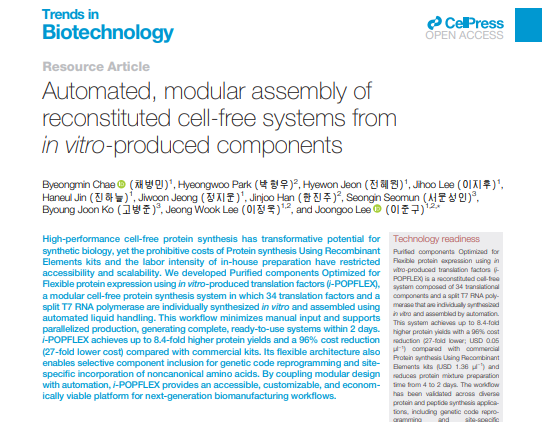
Automated, modular assembly of reconstituted cell-free systems from in vitro-produced components(Trends in Biotechnology, 2026) (JCR 5%)
High-performance cell-free protein synthesis has transformative potential for synthetic biology, yet the prohibitive costs of Protein synthesis Using Recombinant Elements kits and the labor intensity of in-house preparation have restricted accessibility and scalability. We developed Purified components Optimized for Flexible protein expression using in vitro-produced translation factors (i-POPFLEX), a modular cell-free protein synthesis system in which 34 translation factors and a split T7 RNA polymerase are individually synthesized in vitro and assembled using automated liquid handling. This workflow minimizes manual input and supports parallelized production, generating complete, ready-to-use systems within 2 days. i-POPFLEX achieves up to 8.4-fold higher protein yields and a 96% cost reduction (27-fold lower cost) compared with commercial kits. Its flexible architecture also enables selective component inclusion for genetic code reprogramming and site-specific incorporation of noncanonical amino acids. By coupling modular design with automation, i-POPFLEX provides an accessible, customizable, and economically viable platform for next-generation biomanufacturing workflows.(Journal citation : Chae, B., Park, H., Jeon, H., Lee, J., Jin, H., Jeong, J., Han, J., Seomun, S., Ko, B.J., Lee, J.W., Lee, J* "Automated, modular assembly of reconstituted cell-free systems from in vitro-produced components" Trends in Biotechnology, (2026))
B. Chae
H. Park
H. Jeon
J. Lee
H. Jin
J. Jeong
Jinjoo Han
S. Seomun
B. J. Ko
Jeong Wook Lee
J. Lee*
-
68
Toward molecular classification architectures for cell-free diagnostics(Current Opinion in Biotechnology, 2026)(JCR 10%)
Cell-free diagnostics have advanced as low-cost, deployable platforms for point-of-care testing, yet most systems are still designed around individual analyte detection rather than the multi-marker decision-making that clinical diagnosis demands. This review proposes that the next translation step is moving from multiplexed detection toward molecular classification architectures converting multiple biomarker inputs into sample-to-answer diagnostic calls without external computation. To frame this, we organize emerging capabilities into a three-layer molecular decision pathway and evaluate howfar each layer has progressed toward integration. Core molecular modules for input reformatting, combinatorial state discrimination, and output classification are individually emerging but remain unconnected, and we identify the preservation of decision fidelity across layers as the central translational challenge for the field.(Journal citation : Lee, J., Lee. J.W.* "Toward molecular classification architectures for cell-free diagnostics", Current Opinion in Biotechnology, 100:103518 (2026))
Jeongmin Lee
Jeong Wook Lee*
-
67
Translating CRISPR-based Diagnostics to the Clinical Use: Strategies for Practical, Amplification-free Platform(The Korean Society for Biotechnology and Bioengineering, 2026)
Recent advances in molecular diagnostics enable precise and objective identification of pathogens at the molecular level. Among these, the CRISPR (clustered regularly interspaced short palindromic repeats)-Cas system, in particular, is rapidly emerging as a next-generation molecular diagnostic platform, due to its inherent specificity and programmability. However, constraints in guide RNA (guide deoxyribonucleic acid, guide deoxyribonucleic acid, g RNA) design, including PAM (protospacer adjacent motif) site requirements and target secondary structure considerations, and insufficient sensitivity continue to hinder its clinical implementation. This review provides a comprehensive overview of CRISPR-based diagnostics for both DNA and RNA targets, with a focus on strategies to overcome PAM constraints, improve target accessibility, and reduce the dependence on pre-amplification. Furthermore, we propose prospective avenues for enhancement, including the integration of sample pretreatment, deep learning-guided gRNA design, and the advancement of multiplexing systems. These advances are expected to accelerate the application of CRISPR diagnostic systems from laboratory research tools into practical clinical platforms, facilitating rapid and effective responses to emerging infectious diseases.(Journal citation : Shim D.Y.†, Sung. D.†, Park. J., Lee. J.W.* "Translating CRISPR-based Diagnostics to the Clinical Use: Strategies for Practical, Amplification-free Platform", The Korean Society for Biotechnology and Bioengineering, 41(2): 1-14 (2026))
Dae Young Shim†
Doeon Sung†
Jiyoung Park
Jeong Wook Lee*
-
66
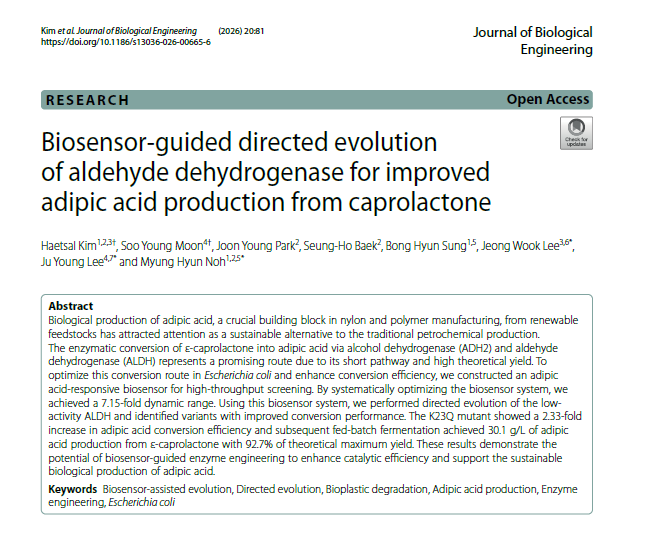
Biosensor-guided Directed Evolution of Aldehyde Dehydrogenase for Improved Adipic Acid Production from Caprolactone(Journal of Biological Engineering, 2026) (JCR 10%)
Biological production of adipic acid, a crucial building block in nylon and polymer manufacturing, from renewable feedstocks has attracted attention as a sustainable alternative to the traditional petrochemical production. The enzymatic conversion of ε-caprolactone into adipic acid via alcohol dehydrogenase (ADH2) and aldehyde dehydrogenase (ALDH) represents a promising route due to its short pathway and high theoretical yield. To optimize this conversion route in Escherichia coli and enhance conversion efficiency, we constructed an adipic acid-responsive biosensor for high-throughput screening. By systematically optimizing the biosensor system, we achieved a 7.15-fold dynamic range. Using this biosensor system, we performed directed evolution of the low-activity ALDH and identified variants with improved conversion performance. The K23Q mutant showed a 2.33-fold increase in adipic acid conversion efficiency and subsequent fed-batch fermentation achieved 30.1 g/L of adipic acid production from ε-caprolactone with 92.7% of theoretical maximum yield. These results demonstrate the potential of biosensor-guided enzyme engineering to enhance catalytic efficiency and support the sustainable biological production of adipic acid.(Journal citation: Kim, H.†, Moon, S.Y.†, Park, J.Y., Baek, S.-H., Sung, B.H., Lee, J.W.*, Lee, J.Y.*, Noh, M.H.* "Biosensor-guided Directed Evolution of Aldehyde Dehydrogenase for Improved Adipic Acid Production from Caprolactone", J Biol Eng, 20:81 (2026))
Haesal Kim†
S.Y. Moon†
J.Y. Park
S.-H Baek
B.H. Sung
Jeong Wook Lee*
J.Y. Lee*
M.H. Noh*
-
65
Fully Biodegradable Electrospun Nanofibrous Membrane for Oil-in-Water Emulsion Separation and Bacterial Filtration (Chemical Engineering Journal, 2026) (JCR 5%)
Electrospun nanofibrous membranes have attracted considerable interest for oily wastewater treatment owing to their high porosity and interconnected pore structures. However, conventional membranes are prone to oil fouling and bacterial biofouling, resulting in shortened service life and environmental concerns regarding end-of-life disposal. Herein, we introduce a fully biodegradable electrospun nanofibrous membrane comprising polycaprolactone (PCL) and kraft lignin (KL) for highly efficient oil-in-water (O/W) emulsion separation and bacterial filtration. The synergistic use of PCL and KL enables a biocompatible, biodegradable, and mechanically durable membrane with enhanced hydrophilicity. Subsequent Layer-by-Layer (LbL) assembly of chitosan (CHI) and carboxymethyl cellulose (CMC) forms a stable hydration layer, supporting robust operation in complex oily wastewater and achieving >99.5% separation efficiency. Moreover, the durability of PCL allows the thin membrane (32 ± 2 μm) to remain self-standing under hydraulic pressure, delivering a high flux of 347 L m−2 h−1 for gasoline-in-water emulsion while maintaining its flux over five cycles of filtration. Furthermore, this membrane achieves a high filtration performance of bacteria with a log reduction value (LRV) greater than 4.0 against E. coli and S. aureus while delivering high flux of 403.7 ± 52.0 and 697.2 ± 76.8 L m−2 h−1, respectively. By integrating fully biodegradable constituents, the presented platform minimizes secondary waste from fabrication through end-of-life disposal, offering a sustainable route to high-flux microfiltration of complex oily effluents.(Journal citation : Lee, J.†, Lee, J., Lee. J.W., Lee, H.* "Fully Biodegradable Electrospun Nanofibrous Membrane for Oil-in-Water Emulsion Separation and Bacterial Filtration", Chem. Eng. J., 553 (2026))
J. Lee
Jiseon Lee
Jeong Wook Lee
H. Lee*
-
64
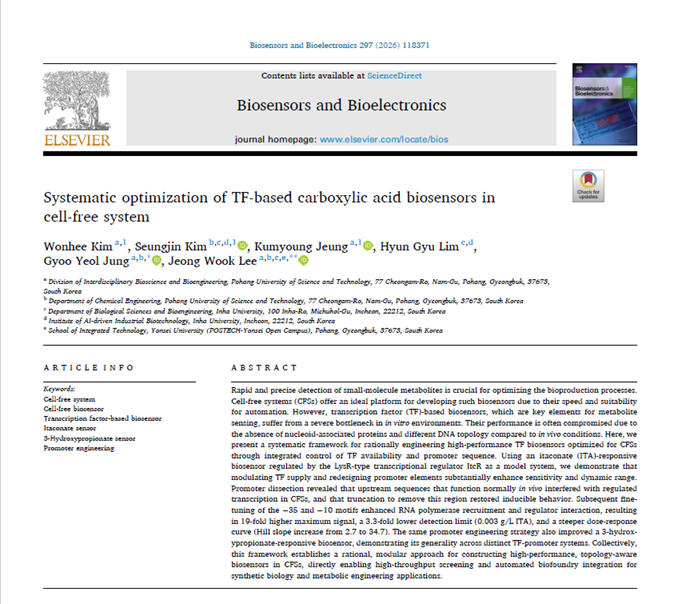
Systematic Optimization of TF-based Carboxylic Acid Biosensors in Cell-Free System (Biosensors and Bioelectronics, 2026) (JCR 5%)
Rapid and precise detection of small-molecule metabolites is crucial for optimizing the bioproduction processes. Cell-free systems (CFSs) offer an ideal platform for developing such biosensors due to their speed and suitability for automation. However, transcription factor (TF)-based biosensors, which are key elements for metabolite sensing, suffer from a severe bottleneck in in vitro environments. Their performance is often compromised due to the absence of nucleoid-associated proteins and different DNA topology compared to in vivo conditions. Here, we present a systematic framework for rationally engineering high-performance TF biosensors optimized for CFSs through integrated control of TF availability and promoter sequence. Using an itaconate (ITA)-responsive biosensor regulated by the LysR-type transcriptional regulator ItcR as a model system, we demonstrate that modulating TF supply and redesigning promoter elements substantially enhance sensitivity and dynamic range. Promoter dissection revealed that upstream sequences that function normally in vivo interfered with regulated transcription in CFSs, and that truncation to remove this region restored inducible behavior. Subsequent fine-tuning of the −35 and −10 motifs enhanced RNA polymerase recruitment and regulator interaction, resulting in 19-fold higher maximum signal, a 3.3-fold lower detection limit (0.003 g/L ITA), and a steeper dose-response curve (Hill slope increase from 2.7 to 34.7). The same promoter engineering strategy also improved a 3-hydroxypropionate-responsive biosensor, demonstrating its generality across distinct TF-promoter systems. Collectively, this framework establishes a rational, modular approach for constructing high-performance, topology-aware biosensors in CFSs, directly enabling high-throughput screening and automated biofoundry integration for synthetic biology and metabolic engineering applications. (Journal citation : Kim, W.H.†, Kim, S.†, Jeung, K.†, Lim, H.G., Jung, G.Y.*, Lee, J.W.* "Systematic Optimization of TF-based Carboxylic Acid Biosensors in Cell-Free System", Biosens. Bioelectron., 297:1-8 (2026))
Won Hee Kim†
S. Kim†
K. Jeung†
H.G. Lim
G.Y. Jung*
Jeong Wook Lee*
-
63
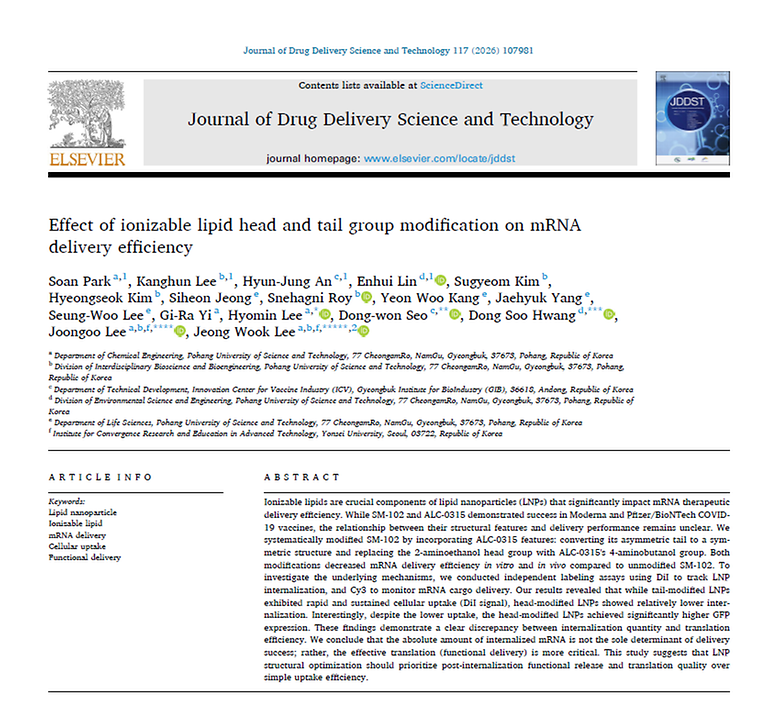
Effect of Ionizable Lipid Head and Tail Group Modification on mRNA Delivery Efficiency (Journal of Drug Delivery Science and Technology, 2026)
Ionizable lipids are crucial components of lipid nanoparticles (LNPs) that significantly impact mRNA therapeutic delivery efficiency. While SM-102 and ALC-0315 demonstrated success in Moderna and Pfizer/BioNTech COVID-19 vaccines, the relationship between their structural features and delivery performance remains unclear. We systematically modified SM-102 by incorporating ALC-0315 features: converting its asymmetric tail to a symmetric structure and replacing the 2-aminoethanol head group with ALC-0315's 4-aminobutanol group. Both modifications decreased mRNA delivery efficiency in vitro and in vivo compared to unmodified SM-102. To investigate the underlying mechanisms, we conducted independent labeling assays using DiI to track LNP internalization, and Cy3 to monitor mRNA cargo delivery. Our results revealed that while tail-modified LNPs exhibited rapid and sustained cellular uptake (DiI signal), head-modified LNPs showed relatively lower internalization. Interestingly, despite the lower uptake, the head-modified LNPs achieved significantly higher GFP expression. These findings demonstrate a clear discrepancy between internalization quantity and translation efficiency. We conclude that the absolute amount of internalized mRNA is not the sole determinant of delivery success; rather, the effective translation (functional delivery) is more critical. This study suggests that LNP structural optimization should prioritize post-internalization functional release and translation quality over simple uptake efficiency. (Journal citation : Park, S.†, Lee, K.†, An, H.-J.†, Lin, E.†, Kim, H., Jeong, S., Roy, S., Kang, Y.W., Yang, J., Lee, S.-W., Yi, G.-R., Lee, H., Seo, D.-w., Hwang, D.S., Lee, J., Lee, J.W.* "Effect of Ionizable Lipid Head and Tail Group Modification on mRNA Delivery Efficiency", J. Drug Deliv. Sci. Technol., 117 (2026))
Soan Park†
K. Lee†
H.-J. An†
E. Lin†
S. Kim
H. Kim
S. Jeong
S. Roy
Y.W. Kang
J. Yang
S.-W. Lee
G.-R. Yi
H. Lee
D.-w. Seo
D.S. Hwang
J. Lee
Jeong Wook Lee*
-
62
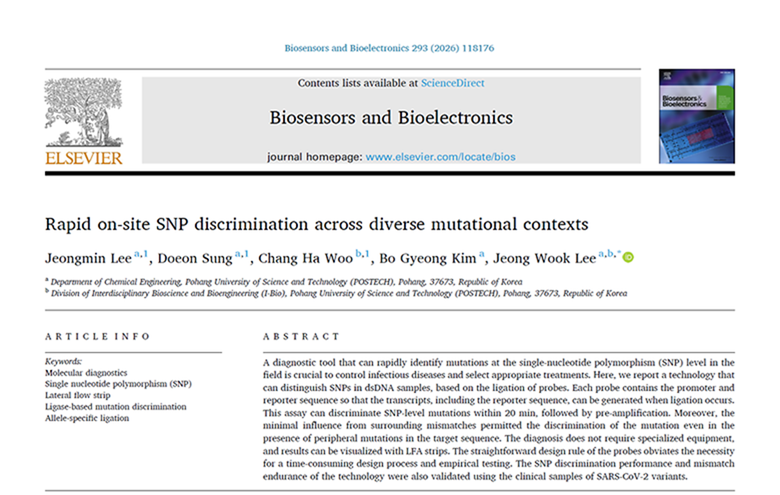
Rapid On-site SNP Discrimination Across Diverse Mutational Contexts (Biosensors and Bioelectronics, 2025) (JCR 5%)
A diagnostic tool that can rapidly identify mutations at the single-nucleotide polymorphism (SNP) level in the field is crucial to control infectious diseases and select appropriate treatments. Here, we report a technology that can distinguish SNPs in dsDNA samples, based on the ligation of probes. Each probe contains the promoter and reporter sequence so that the transcripts, including the reporter sequence, can be generated when ligation occurs. This assay can discriminate SNP-level mutations within 20 min, followed by pre-amplification. Moreover, the minimal influence from surrounding mismatches permitted the discrimination of the mutation even in the presence of peripheral mutations in the target sequence. The diagnosis does not require specialized equipment, and results can be visualized with LFA strips. The straightforward design rule of the probes obviates the necessity for a time-consuming design process and empirical testing. The SNP discrimination performance and mismatch endurance of the technology were also validated using the clinical samples of SARS-CoV-2 variants. (Journal citation : Lee, J.†, Sung, D.†, Woo, C.H.†, Kim, B.G., and Lee. J.W.* “Rapid On-site SNP Discrimination Across Diverse Mutational Contexts", Biosens. Bioelectron., 293:1-11 (2025))
Jeongmin Lee†
Doeon Sung†
Chang Ha Woo†
Bo Gyeong Kim
Jeong Wook Lee*
-
61
AI-based Genetic Circuit Design
Submitted, 2025
S. Palacios†
Euijin Seo†
Yungon Do†
Sohun Lee†
-
60
Deep Generative Model–Driven Design of Microbial Synthetic Promoters (Journal of Microbiology and Biotechnology, 2025)
A synthetic promoter is an artificially designed DNA sequence based on naturally occurring promoter elements, enabling more precise control of gene expression than natural promoters. Design of synthetic promoters with tunable expression levels is key to precise genetic regulation in microbes, supporting metabolic engineering, natural product biosynthesis, and diverse biotechnological applications. Recent advances in deep learning have made it possible to generate functional synthetic promoters using deep generative models (DGMs). Such approaches dramatically accelerate the traditionally labor-intensive and time-consuming process of experimental promoter design, enabling the efficient discovery of synthetic promoters. In synthetic promoter generation, three major types of DGMs have been predominantly employed: variational autoencoders (VAEs), generative adversarial networks (GANs), and diffusion models. VAEs reconstruct promoters through latent feature learning, GANs create realistic promoter sequences via adversarial training, and diffusion models iteratively denoise random inputs to generate high-fidelity synthetic promoters. This review outlines deep learning–based strategies for synthetic promoter design, encompassing data acquisition, promoter generation, and validation of promoters generated by DGMs. (Journal citation : Seo, E., Sung, D., Lee, J.W.* "Deep Generative Model–Driven Design of Microbial Synthetic Promoters", J. Mol. Microbiol. Biotechnol., 35: 1-11 (2025))
Euijin Seo
Doeon Sung
Jeong Wook Lee*