-
59
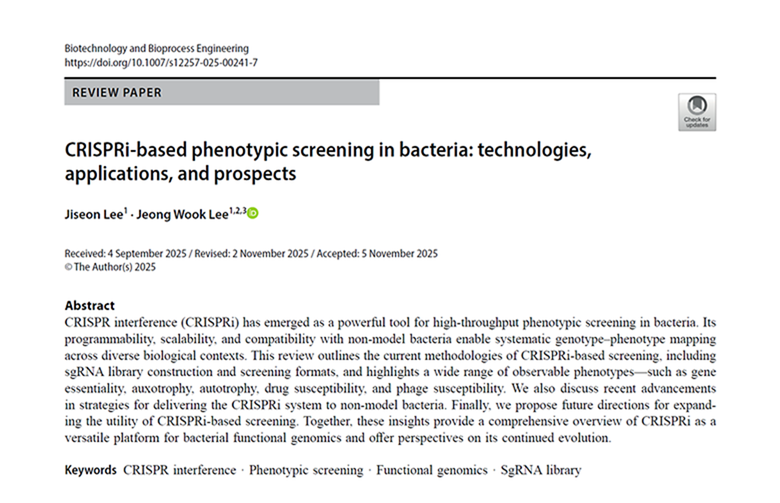
CRISPRi-Based Phenotypic Screening in Bacteria: Technologies, Applications, and Prospects (Biotechnology and Bioprocess Engineering, 2026)
CRISPR interference (CRISPRi) has emerged as a powerful tool for high-throughput phenotypic screening in bacteria. Its programmability, scalability, and compatibility with non-model bacteria enable systematic genotype–phenotype mapping across diverse biological contexts. This review outlines the current methodologies of CRISPRi-based screening, including sgRNA library construction and screening formats, and highlights a wide range of observable phenotypes—such as gene essentiality, auxotrophy, autotrophy, drug susceptibility, and phage susceptibility. We also discuss recent advancements in strategies for delivering the CRISPRi system to non-model bacteria. Finally, we propose future directions for expanding the utility of CRISPRi-based screening. Together, these insights provide a comprehensive overview of CRISPRi as a versatile platform for bacterial functional genomics and offer perspectives on its continued evolution. (Journal citation: Lee, J., Lee, J.W.* "CRISPRi-Based Phenotypic Screening in Bacteria: Technologies, Applications, and Prospects", Biotechnology and Bioprocess Engineering, 1-11 (2025))
Jiseon Lee
Jeong Wook Lee*
-
58
Metabolic engineering of acetogenic bacteria using CO gas-sensing transcriptional ON/OFF modules (Metabolic Engineering, 2025) (JCR 10%)
Dynamic sensing of gas substrates like toxic carbon monoxide (CO) in living microbial cells is often limited due to the lack of suitable biosensors. Here, we integrated the CO-binding transcription activators, CooA and RcoM1, with an O 2-independent fluorescent reporter system, Halo-tag, to develop CO-sensing modules (ON/OFF) capable of detecting CO concentrations in the strictly anaerobic acetogenic bacterium Eubacterium limosum. Furthermore, we employed CooA as the CO-sensing ON module to activate the target genes for 2,3-butanediol (2,3-BDO) biosynthesis, achieving a 1.7-fold increase in 2,3-BDO yield. These results indicate that the CO-ON module effectively redirects carbon flux toward target product biosynthesis pathway in acetogens. However, during CO gas with glucose mixotrophic fermentation, lactate emerged as the predominant product. To enhance target pathway flux using the CO-ON module, we deleted the lactate pathway in E. limosum using CRISPR/Cas9. The resulting engineered strain showed an 18.5 % increase in carbon utilization for 2,3-BDO production under CO sensing culture conditions. This optimized platform strain subsequently produced approximately 52 g/L of 2,3- BDO during two stage CO-glucose mixotrophic fermentation. Our results provide orthogonal CO-sensing transcriptional regulatory modules for engineering metabolic pathways that efficiently convert CO into value-added biochemicals using acetogenic biocatalysts. (Journal citation: Jin, S., Ganesh Irisappan, Bae, J., Lee, D., Kand, S., Lee, H., Lee, J.W.*, Cho, B.-k.* "Metabolic engineering of acetogenic bacteria using CO gas-sensing transcriptional ON/OFF modules", Metab. Eng, 91:290-301)
S. Jin
Irisappan Ganesh
J. Bae
D. Lee
S. Kang
H. Lee
Jeong Wook Lee*
B.-K. Cho*
-
57
Expanding the Genetic Code: Strategies for Noncanonical Amino Acid Incorporation in Biopolymer (Bioresource Technology, 2025) (JCR 5%)
Codon expansion has become a powerful tool for overcoming the limitations of the standard genetic code system, which restricts the building block of proteins to canonical amino acids. The incorporation of non-canonical amino acids (ncAAs) into proteins presents a significant opportunity to expand their functional diversity. The precise incorporation of ncAAs in vivo requires an orthogonal tRNA/aminoacyl-tRNA synthetase pair and a blank codon to assign them. Studies have focused on the biosynthesis of proteins with novel chemical properties alongside biotechnological advancements in codon expansion research. The three principal strategies for codon expansion are: stop codon utilization, quadruplet codon generation, and sense codon compression. Although using stop codons as blank codons remains an effective approach, the need for additional blank codons has expanded research into quadruplet codons and sense-codon compression. This review presents an overview of each strategy by integrating recent advances in research. We discuss the advantages and limitations of these strategies, as well as the challenges encountered. Subsequently, we propose potential approaches to enhance the efficiency and fidelity of ncAA incorporation. The insights presented in this review provide perspectives for future research and facilitate the advancement of codon expansion and its applications in biotechnology. (Journal citation: Kim, D.†, Sung, D.†, Lee, J.W.* "Expanding the Genetic Code: Strategies for Noncanonical Amino Acid Incorporation in Biopolymer", Bioresource Biotechnol., 432:1-13 (2025))
Donghyeon Kim†
Doeon Sung†
Jeong Wook Lee*
-
56
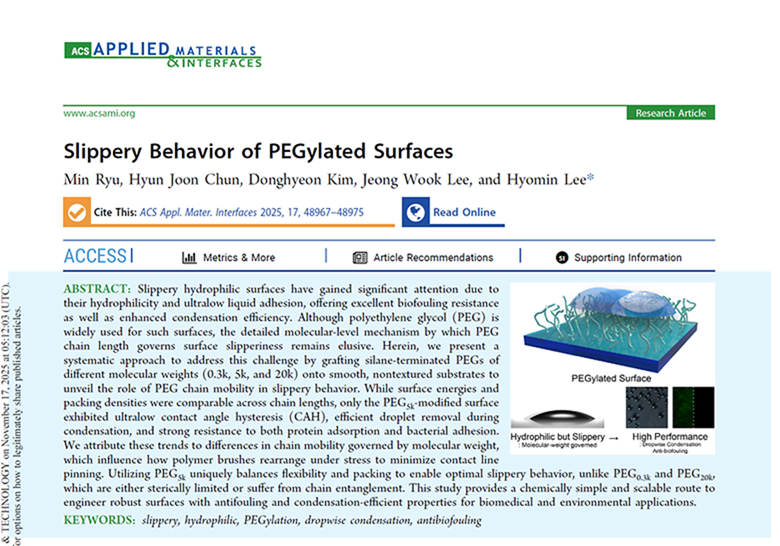
Slippery Behavior of PEGylated Surfaces (ACS Applied Materials & Interfaces, 2025)
Slippery hydrophilic surfaces have gained significant attention due to their hydrophilicity and ultralow liquid adhesion, offering excellent biofouling resistance as well as enhanced condensation efficiency. Although polyethylene glycol (PEG) is widely used for such surfaces, the detailed molecular-level mechanism by which PEG chain length governs surface slipperiness remains elusive. Herein, we present a systematic approach to address this challenge by grafting silane-terminated PEGs of different molecular weights (0.3k, 5k, and 20k) onto smooth, nontextured substrates to unveil the role of PEG chain mobility in slippery behavior. While surface energies and packing densities were comparable across chain lengths, only the PEG5k-modified surface exhibited ultralow contact angle hysteresis (CAH), efficient droplet removal during condensation, and strong resistance to both protein adsorption and bacterial adhesion. We attribute these trends to differences in chain mobility governed by molecular weight, which influence how polymer brushes rearrange under stress to minimize contact line pinning. Utilizing PEG5k uniquely balances flexibility and packing to enable optimal slippery behavior, unlike PEG0.3k and PEG20k, which are either sterically limited or suffer from chain entanglement. This study provides a chemically simple and scalable route to engineer robust surfaces with antifouling and condensation-efficient properties for biomedical and environmental applications. (Journal citation : Ryu, M., Chun, H.J., Kim, D., Lee, J.W., Lee, H.* "Slippery Behavior of PEGylated Surfaces" ACS Appl. Mater. Interfaces., 17(34):48967-48975 (2025))
M. Ryu
H.J. Chun
Donghyeon Kim
Jeong Wook Lee
H.Lee*
-
55
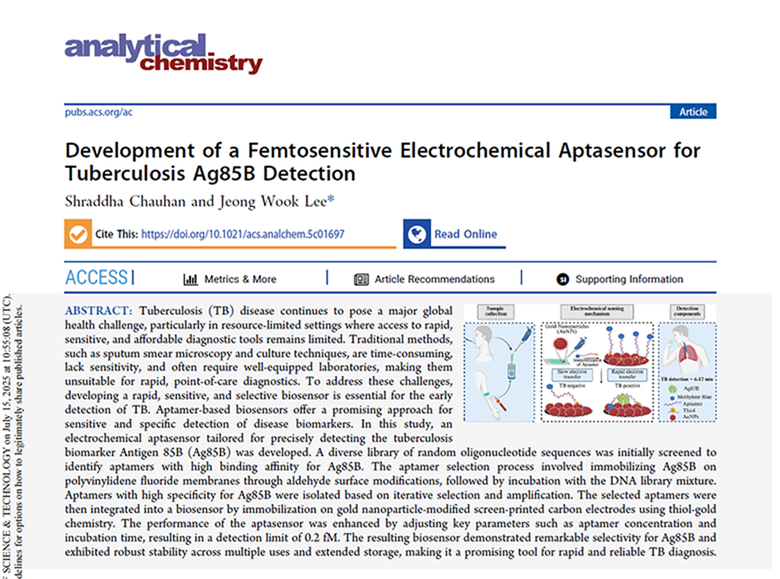
Development of a Femtosensitive Electrochemical Aptasensor for Tuberculosis Ag85B Detection (Analytical Chemistry, 2025) (JCR 10%)
Tuberculosis (TB) disease continues to pose a major global health challenge, particularly in resource-limited settings where access to rapid, sensitive, and affordable diagnostic tools remains limited. Traditional methods, such as sputum smear microscopy and culture techniques, are time-consuming, lack sensitivity, and often require well-equipped laboratories, making them unsuitable for rapid, point-of-care diagnostics. To address these challenges, developing a rapid, sensitive, and selective biosensor is essential for the early detection of TB. Aptamer-based biosensors offer a promising approach for sensitive and specific detection of disease biomarkers. In this study, an electrochemical aptasensor tailored for precisely detecting the tuberculosis biomarker Antigen 85B (Ag85B) was developed. A diverse library of random oligonucleotide sequences was initially screened to identify aptamers with high binding affinity for Ag85B. The aptamer selection process involved immobilizing Ag85B on polyvinylidene fluoride membranes through aldehyde surface modifications, followed by incubation with the DNA library mixture. Aptamers with high specificity for Ag85B were isolated based on iterative selection and amplification. The selected aptamers were then integrated into a biosensor by immobilization on gold nanoparticle-modified screen-printed carbon electrodes using thiol-gold chemistry. The performance of the aptasensor was enhanced by adjusting key parameters such as aptamer concentration and incubation time, resulting in a detection limit of 0.2 fM. The resulting biosensor demonstrated remarkable selectivity for Ag85B and exhibited robust stability across multiple uses and extended storage, making it a promising tool for rapid and reliable TB diagnosis. (Journal citation : Anal. Chem., 1:1-10 (2025))
Shraddha Chauhan
Jeong Wook Lee*
-
54
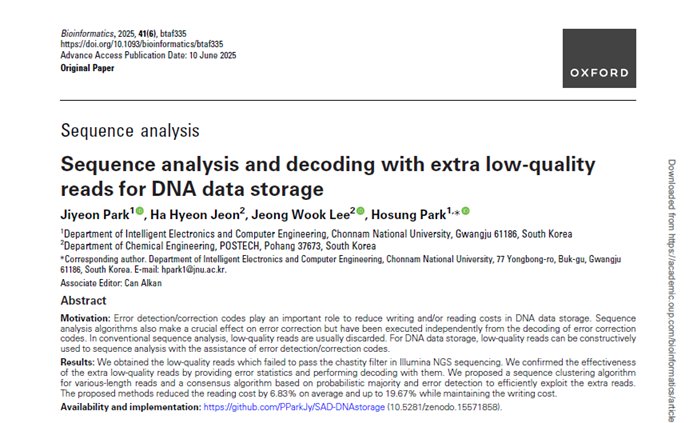
Sequence Analysis and Decoding with Extra Low-Quality Reads for DNA Data Storage (Bioinformatics, 2025) (JCR 10%)
Error detection/correction codes play an important role to reduce writing and/or reading costs in DNA data storage. Sequence analysis algorithms also make a crucial effect on error correction but have been executed independently from the decoding of error correction codes. In conventional sequence analysis, low-quality reads are usually discarded. For DNA data storage, low-quality reads can be constructively used to sequence analysis with the assistance of error detection/correction codes. We obtained the low-quality reads which failed to pass the chastity filter in Illumina NGS sequencing. We confirmed the effectiveness of the extra low-quality reads by providing error statistics and performing decoding with them. We proposed a sequence clustering algorithm for various-length reads and a consensus algorithm based on probabilistic majority and error detection to efficiently exploit the extra reads. The proposed methods reduced the reading cost by 6.83% on average and up to 19.67% while maintaining the writing cost. (Journal citation : Bioinform., 41(6):1-9 (2025))
J. Park
Ha Hyeon Jeon
Jeong Wook Lee
H. Park*
-
53
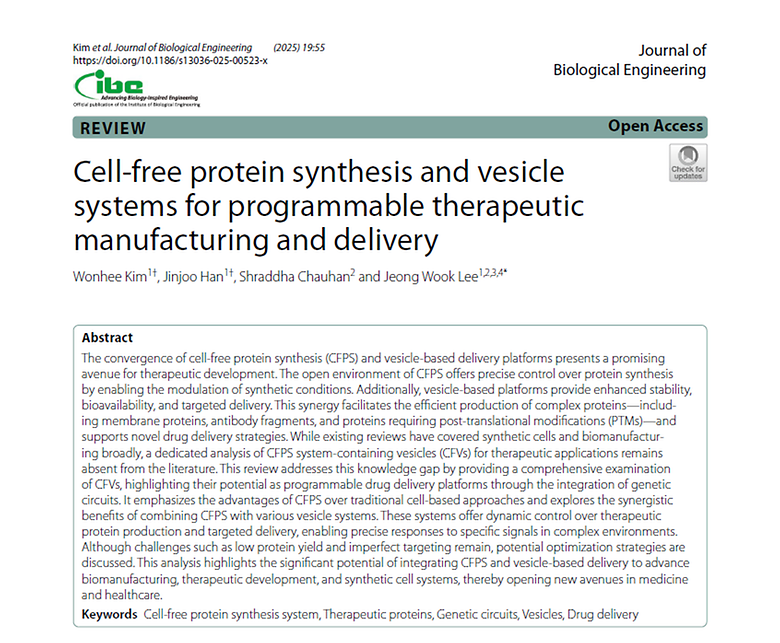
Cell-free protein synthesis and vesicle systems for programmable therapeutic manufacturing and delivery (Journal of Biological Engineering, 2025) (JCR 10%)
The convergence of cell-free protein synthesis (CFPS) and vesicle-based delivery platforms presents a promising avenue for therapeutic development. The open environment of CFPS offers precise control over protein synthesis by enabling the modulation of synthetic conditions. Additionally, vesicle-based platforms provide enhanced stability, bioavailability, and targeted delivery. This synergy facilitates the efficient production of complex proteins—including membrane proteins, antibody fragments, and proteins requiring post-translational modifications (PTMs)—and supports novel drug delivery strategies. While existing reviews have covered synthetic cells and biomanufacturing broadly, a dedicated analysis of CFPS system-containing vesicles (CFVs) for therapeutic applications remains absent from the literature. This review addresses this knowledge gap by providing a comprehensive examination of CFVs, highlighting their potential as programmable drug delivery platforms through the integration of genetic circuits. It emphasizes the advantages of CFPS over traditional cell-based approaches and explores the synergistic benefits of combining CFPS with various vesicle systems. These systems offer dynamic control over therapeutic protein production and targeted delivery, enabling precise responses to specific signals in complex environments. Although challenges such as low protein yield and imperfect targeting remain, potential optimization strategies are discussed. This analysis highlights the significant potential of integrating CFPS and vesicle-based delivery to advance biomanufacturing, therapeutic development, and synthetic cell systems, thereby opening new avenues in medicine and healthcare. (Journal citation : J. Biol. Eng., 55:1-17 (2025))
Won Hee Kim†
Jinjoo Han†
Shraddha Chauhan
Jeong Wook Lee*
-
52
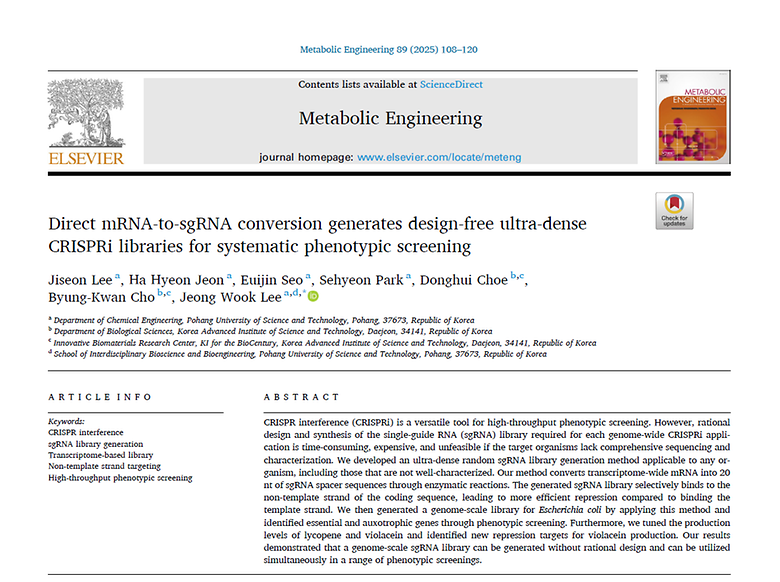
Direct mRNA-to-sgRNA Conversion Generates Design-Free Ultra-Dense CRISPRi Libraries for Systematic Phenotypic Screening (Metabolic Engineering, 2025) (JCR 10%)
CRISPR interference (CRISPRi) is a versatile tool for high-throughput phenotypic screening. However, rational design and synthesis of the single-guide RNA (sgRNA) library required for each genome-wide CRISPRi application is time-consuming, expensive, and unfeasible if the target organisms lack comprehensive sequencing and characterization. We developed an ultra-dense random sgRNA library generation method applicable to any organism, including those that are not well-characterized. Our method converts transcriptome-wide mRNA into 20 nt of sgRNA spacer sequences through enzymatic reactions. The generated sgRNA library selectively binds to the non-template strand of the coding sequence, leading to more efficient repression compared to binding the template strand. We then generated a genome-scale library for Escherichia coli by applying this method and identified essential and auxotrophic genes through phenotypic screening. Furthermore, we tuned the production levels of lycopene and violacein and identified new repression targets for violacein production. Our results demonstrated that a genome-scale sgRNA library can be generated without rational design and can be utilized simultaneously in a range of phenotypic screenings. (Journal citation : Metab. Eng., 89:108-120 (2025))
Jiseon Lee
Ha Hyeon Jeon
Euijin Seo
Sehyeon Park
D. Choe
B.-K. Cho
Jeong Wook Lee*
-
51
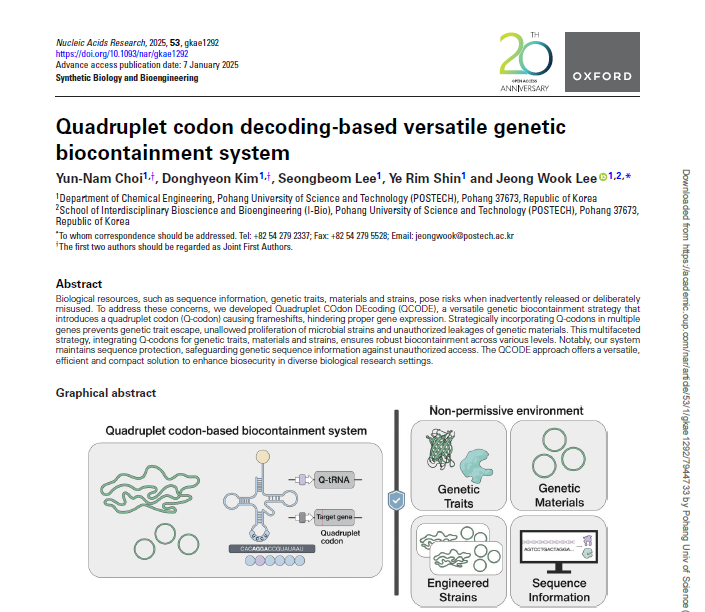
Quadruplet codon decoding-based versatile genetic biocontainment system (Nucleic Acids Research, 2025) (JCR 5%)
Biological resources, such as sequence information, genetic traits, materials and strains, pose risks when inadvertently released or deliberately misused. To address these concerns, we developed Quadruplet COdon DEcoding (QCODE), a versatile genetic biocontainment strategy that introduces a quadruplet codon (Q-codon) causing frameshifts, hindering proper gene expression. Strategically incorporating Q-codons in multiple genes prevents genetic trait escape, unallowed proliferation of microbial strains and unauthorized leakages of genetic materials. This multifaceted strategy, integrating Q-codons for genetic traits, materials and strains, ensures robust biocontainment across various levels. Notably, our system maintains sequence protection, safeguarding genetic sequence information against unauthorized access. The QCODE approach offers a versatile, efficient and compact solution to enhance biosecurity in diverse biological research settings. (Journal citation : Nucleic Acids Res., 53(1):1-13 (2025))
Yun-Nam Choi†
Donghyeon Kim†
Sungbeom Lee
Ye Rim Shin
Jeong Wook Lee*
-
50
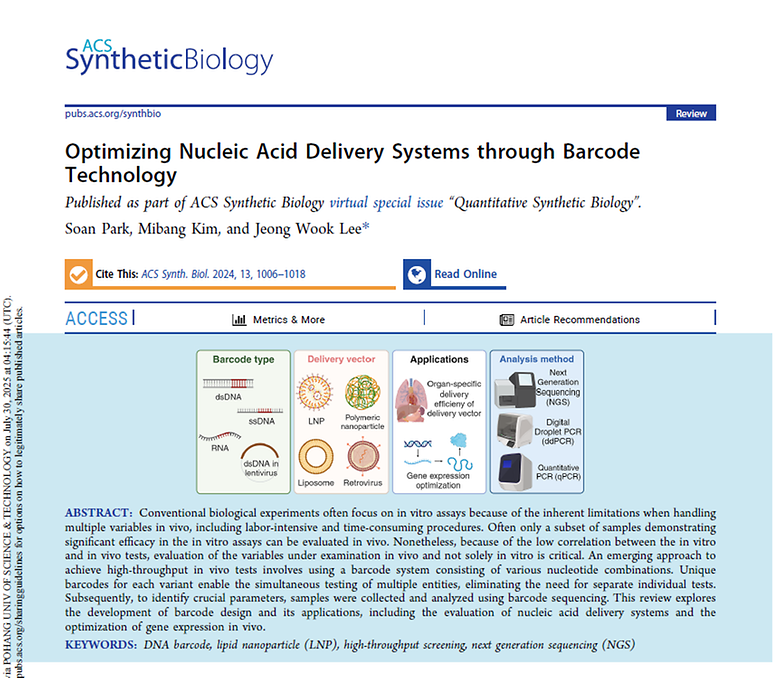
Optimizing nucleic acid delivery systems through barcode technology (ACS Synthetic Biology, 2024)
Conventional biological experiments often focus on in vitro assays because of the inherent limitations when handling multiple variables in vivo, including labor-intensive and time-consuming procedures. Often only a subset of samples demonstrating significant efficacy in the in vitro assays can be evaluated in vivo. Nonetheless, because of the low correlation between the in vitro and in vivo tests, evaluation of the variables under examination in vivo and not solely in vitro is critical. An emerging approach to achieve high-throughput in vivo tests involves using a barcode system consisting of various nucleotide combinations. Unique barcodes for each variant enable the simultaneous testing of multiple entities, eliminating the need for separate individual tests. Subsequently, to identify crucial parameters, samples were collected and analyzed using barcode sequencing. This review explores the development of barcode design and its applications, including the evaluation of nucleic acid delivery systems and the optimization of gene expression in vivo. (Journal citation : ACS Synth. Biol., 13(4):1006-1018 (2024))
Soan Park
Mibang Kim
Jeong Wook Lee*