-
49
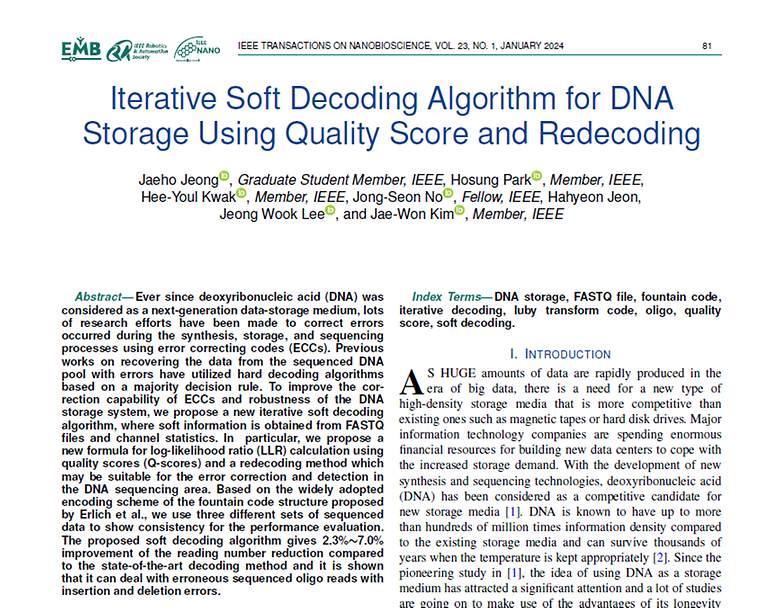
Iterative Soft Decoding Algorithm for DNA Storage Using Quality Score and Redecoding (IEEE Transactions on NanoBioscience, 2024)
Ever since deoxyribonucleic acid (DNA) was considered as a next-generation data-storage medium, lots of research efforts have been made to correct errors occurred during the synthesis, storage, and sequencing processes using error correcting codes (ECCs). Previous works on recovering the data from the sequenced DNA pool with errors have utilized hard decoding algorithms based on a majority decision rule. To improve the correction capability of ECCs and robustness of the DNA storage system, we propose a new iterative soft decoding algorithm, where soft information is obtained from FASTQ files and channel statistics. In particular, we propose a new formula for log-likelihood ratio (LLR) calculation using quality scores (Q-scores) and a redecoding method which may be suitable for the error correction and detection in the DNA sequencing area. Based on the widely adopted encoding scheme of the fountain code structure proposed by Erlich et al., we use three different sets of sequenced data to show consistency for the performance evaluation. The proposed soft decoding algorithm gives 2.3% ∼ 7.0% improvement of the reading number reduction compared to the state-of-the-art decoding method and it is shown that it can deal with erroneous sequenced oligo reads with insertion and deletion errors. (Journal citation : IEEE Trans. Nanobioscience, 23(1):81-90 (2024))
J. Jeong
H. Park
H.Y. Kwak
J.-S. No
Ha Hyeon Jeon
Jeong Wook Lee
-
48
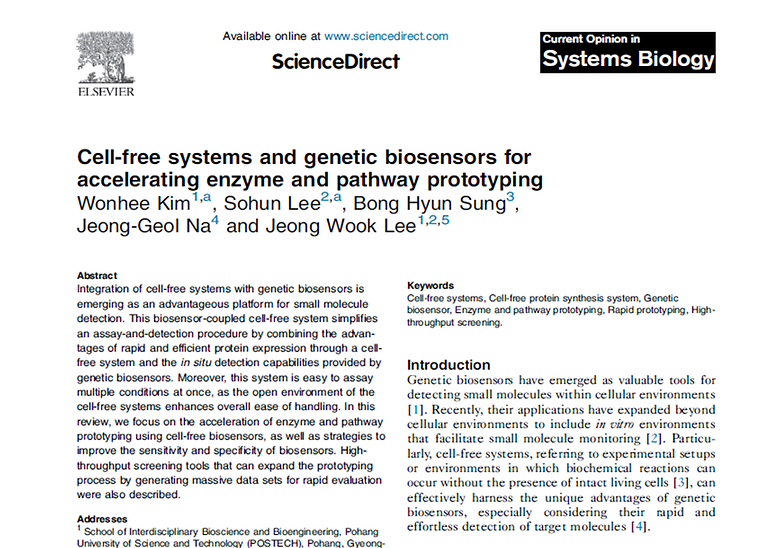
Cell-free systems and genetic biosensors for accelerating enzyme and pathway prototyping (Current Opinion in Systems Biology, 2024)
Integration of cell-free systems with genetic biosensors is emerging as an advantageous platform for small molecule detection. This biosensor-coupled cell-free system simplifies an assay-and-detection procedure by combining the advantages of rapid and efficient protein expression through a cell-free system and the in situ detection capabilities provided by genetic biosensors. Moreover, this system is easy to assay multiple conditions at once, as the open environment of the cell-free systems enhances overall ease of handling. In this review, we focus on the acceleration of enzyme and pathway prototyping using cell-free biosensors, as well as strategies to improve the sensitivity and specificity of biosensors. High-throughput screening tools that can expand the prototyping process by generating massive data sets for rapid evaluation were also described. (Journal citation : Curr. Opin. Syst. Biol. (2024))
Won Hee Kim†
Sohun Lee†
B.H. Sung*
-
47
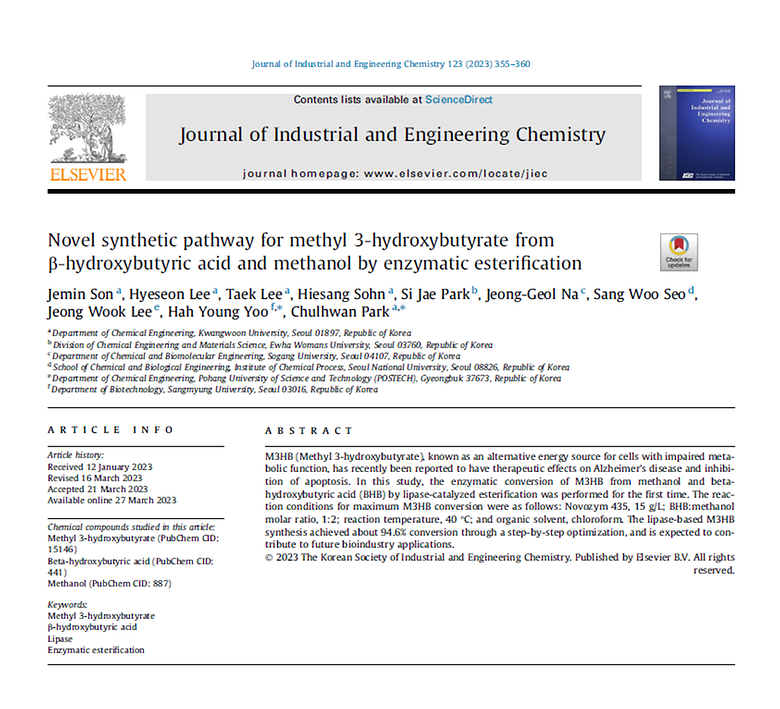
Novel synthetic pathway for methyl 3-hydroxybutyrate from β-hydroxybutyric acid and methanol by enzymatic esterification (Journal of Industrial and Engineering Chemistry, 2023)
M3HB (Methyl 3-hydroxybutyrate), known as an alternative energy source for cells with impaired metabolic function, has recently been reported to have therapeutic effects on Alzheimer's disease and inhibition of apoptosis. In this study, the enzymatic conversion of M3HB from methanol and beta-hydroxybutyric acid (BHB) by lipase-catalyzed esterification was performed for the first time. The reaction conditions for maximum M3HB conversion were as follows: Novozym 435, 15 g/L; BHB:methanol molar ratio, 1:2; reaction temperature, 40 °C; and organic solvent, chloroform. The lipase-based M3HB synthesis achieved about 94.6% conversion through a step-by-step optimization, and is expected to contribute to future bioindustry applications. (Journal citation : J. Ind. Eng. Chem., 123:355-360 (2023))
J. Son
H. Lee
T. Lee
H. Sohn
S.J. Park
J.-G. Na
S.W. Seo
Jeong Wook Lee
Y.Y. Hah
C. Park
-
46
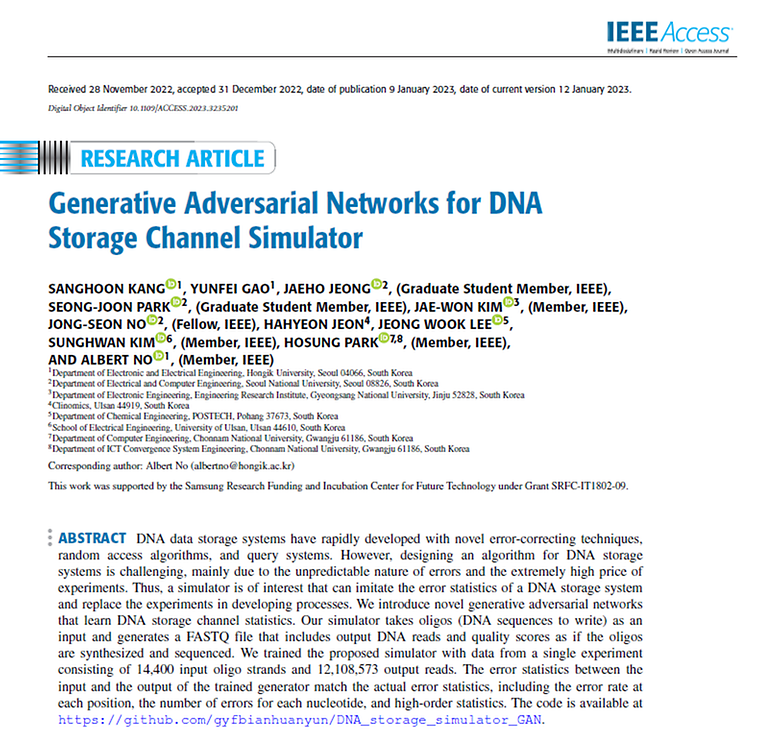
Generative Adversarial Networks for DNA Storage Channel Simulator (IEEE Access, 2023)
ecting techniques, random access algorithms, and query systems. However, designing an algorithm for DNA storage systems is challenging, mainly due to the unpredictable nature of errors and the extremely high price of experiments. Thus, a simulator is of interest that can imitate the error statistics of a DNA storage system and replace the experiments in developing processes. We introduce novel generative adversarial networks that learn DNA storage channel statistics. Our simulator takes oligos (DNA sequences to write) as an input and generates a FASTQ file that includes output DNA reads and quality scores as if the oligos are synthesized and sequenced. We trained the proposed simulator with data from a single experiment consisting of 14,400 input oligo strands and 12,108,573 output reads. The error statistics between the input and the output of the trained generator match the actual error statistics, including the error rate at each position, the number of errors for each nucleotide, and high-order statistics. The code is available at https://github.com/gyfbianhuanyun/DNA_storage_simulator_GAN. (Journal citation : IEEE Access, 11:3781-3793 (2023))
S. Kang
Y. Gao
J. Jeong
S.-J. Park
J.-W. Kim
J.-S. No
Ha Hyeon Jeon
Jeong Wook Lee
S.H. Kim
H. Park
A. No
-
45
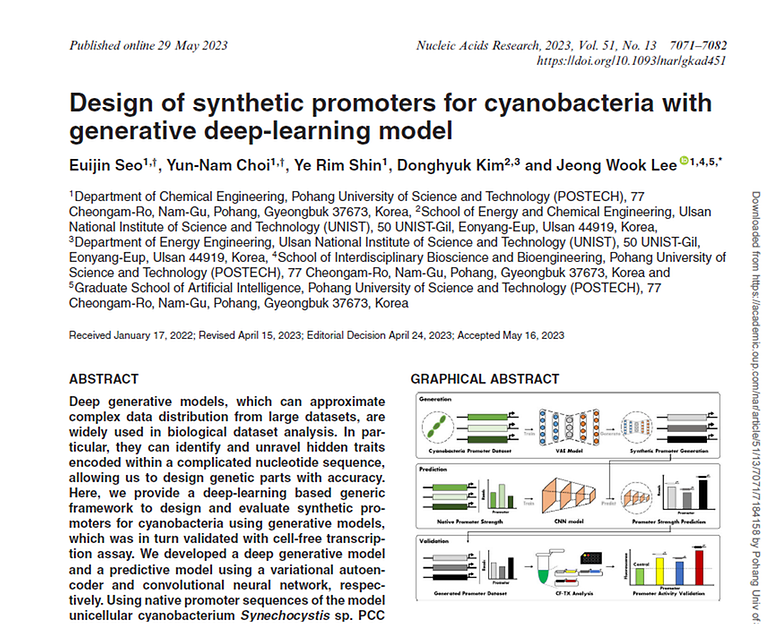
Design of synthetic promoters for cyanobacteria with generative deep-learning model (Nucleic Acids Research, 2023) (JCR 5%)
Deep generative models, which can approximate complex data distribution from large datasets, are widely used in biological dataset analysis. In particular, they can identify and unravel hidden traits encoded within a complicated nucleotide sequence, allowing us to design genetic parts with accuracy. Here, we provide a deep-learning based generic framework to design and evaluate synthetic promoters for cyanobacteria using generative models, which was in turn validated with cell-free transcription assay. We developed a deep generative model and a predictive model using a variational autoencoder and convolutional neural network, respectively. Using native promoter sequences of the model unicellular cyanobacterium Synechocystis sp. PCC 6803 as a training dataset, we generated 10 000 synthetic promoter sequences and predicted their strengths. By position weight matrix and k-mer analyses, we confirmed that our model captured a valid feature of cyanobacteria promoters from the dataset. Furthermore, critical subregion identification analysis consistently revealed the importance of the -10 box sequence motif in cyanobacteria promoters. Moreover, we validated that the generated promoter sequence can efficiently drive transcription via cell-free transcription assay. This approach, combining in silico and in vitro studies, will provide a foundation for the rapid design and validation of synthetic promoters, especially for non-model organisms. (Journal citation : Nucleic Acids Res., 51(13):7071–7082 (2023))
Euijin Seo†
Yun-Nam Choi†
Ye Rim Shin
D. Kim
Jeong Wook Lee*
-
44
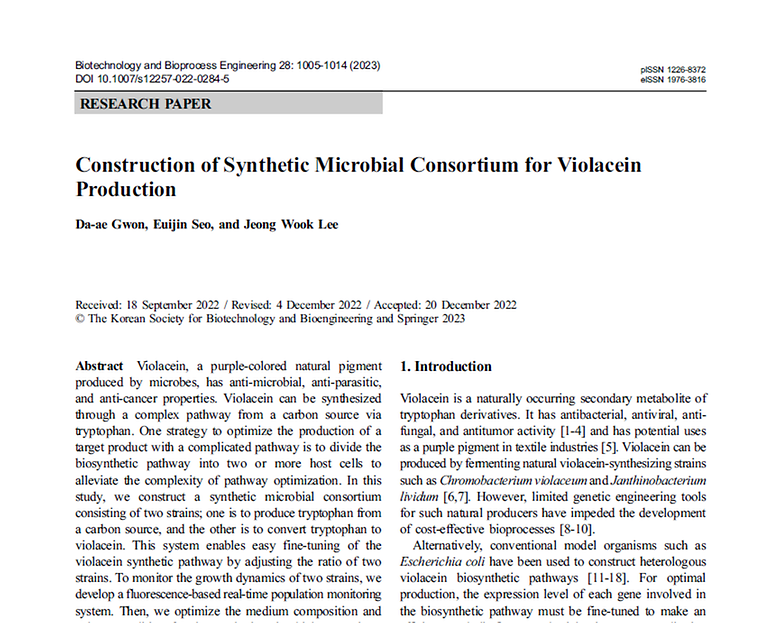
Construction of Synthetic Microbial Consortium for Violacein Production (Biotechnology and Bioprocess Engineering, 2023)
Violacein, a purple-colored natural pigment produced by microbes, has anti-microbial, anti-parasitic, and anti-cancer properties. Violacein can be synthesized through a complex pathway from a carbon source via tryptophan. One strategy to optimize the production of a target product with a complicated pathway is to divide the biosynthetic pathway into two or more host cells to alleviate the complexity of pathway optimization. In this study, we construct a synthetic microbial consortium consisting of two strains; one is to produce tryptophan from a carbon source, and the other is to convert tryptophan to violacein. This system enables easy fine-tuning of the violacein synthetic pathway by adjusting the ratio of two strains. To monitor the growth dynamics of two strains, we develop a fluorescence-based real-time population monitoring system. Then, we optimize the medium composition and culture condition for the synthetic microbial consortium, including carbon sources, initial inoculation ratios, induction timings, and surfactants. With the optimized condition for the consortium, we improved violacein production 2.79-fold in titer. (Journal citation : Biotechnol. Bioprocess Eng., 1-10 (2023))
Da-ae Gwon
Euijin Seo
Jeong Wook Lee*
-
43
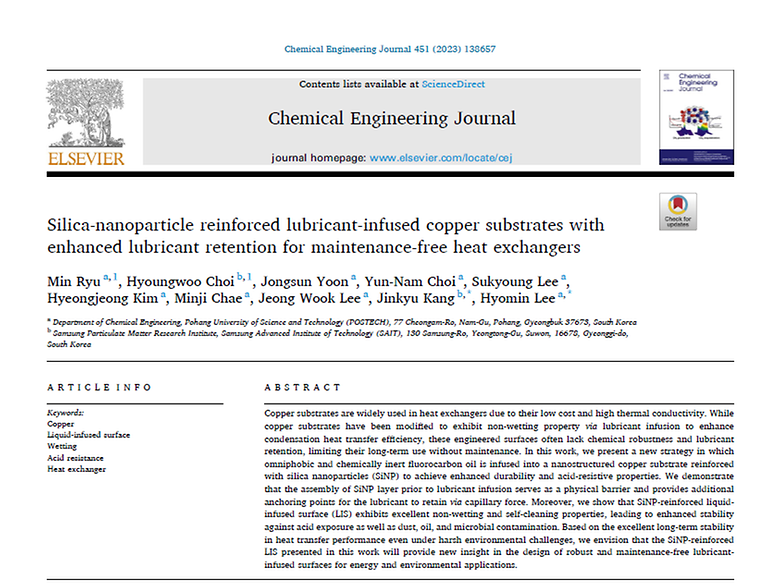
Silica-Nanoparticle Reinforced Lubricant-Infused Copper Substrates with Enhanced Lubricant Retention for Maintenance-Free Heat Exchangers (Chemical Engineering Journal, 2023) (JCR 3%)
Copper substrates are widely used in heat exchangers due to their low cost and high thermal conductivity. While copper substrates have been modified to exhibit non-wetting property via lubricant infusion to enhance condensation heat transfer efficiency, these engineered surfaces often lack chemical robustness and lubricant retention, limiting their long-term use without maintenance. In this work, we present a new strategy in which omniphobic and chemically inert fluorocarbon oil is infused into a nanostructured copper substrate reinforced with silica nanoparticles (SiNP) to achieve enhanced durability and acid-resistive properties. We demonstrate that the assembly of SiNP layer prior to lubricant infusion serves as a physical barrier and provides additional anchoring points for the lubricant to retain via capillary force. Moreover, we show that SiNP-reinforced liquid-infused surface (LIS) exhibits excellent non-wetting and self-cleaning properties, leading to enhanced stability against acid exposure as well as dust, oil, and microbial contamination. Based on the excellent long-term stability in heat transfer performance even under harsh environmental challenges, we envision that the SiNP-reinforced LIS presented in this work will provide new insight in the design of robust and maintenance-free lubricant-infused surfaces for energy and environmental applications. (Journal citation : Chem. Eng. J. 451:138657 (2023))
M. Ryu†
H. Choi†
J. Yoon
Yun-Nam Choi
S. Lee
H. Kim
M. Chae
Jeong Wook Lee
J. Kang
H. Lee
-
42
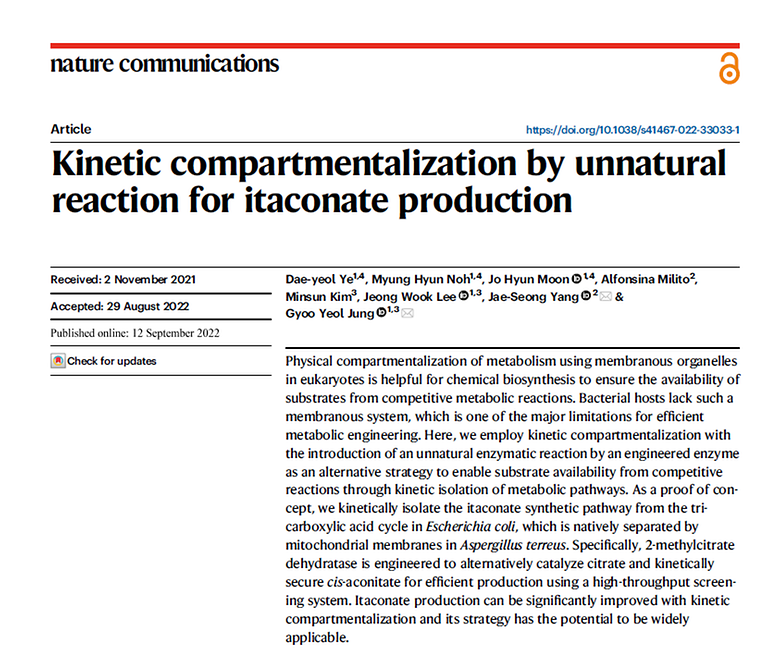
Kinetic Compartmentalization by Unnatural Reaction for Itaconate Production (Nature Communications, 2022) (JCR 10%)
Physical compartmentalization of metabolism using membranous organelles in eukaryotes is helpful for chemical biosynthesis to ensure the availability of substrates from competitive metabolic reactions. Bacterial hosts lack such a membranous system, which is one of the major limitations for efficient metabolic engineering. Here, we employ kinetic compartmentalization with the introduction of an unnatural enzymatic reaction by an engineered enzyme as an alternative strategy to enable substrate availability from competitive reactions through kinetic isolation of metabolic pathways. As a proof of concept, we kinetically isolate the itaconate synthetic pathway from the tricarboxylic acid cycle in Escherichia coli, which is natively separated by mitochondrial membranes in Aspergillus terreus. Specifically, 2-methylcitrate dehydratase is engineered to alternatively catalyze citrate and kinetically secure cis-aconitate for efficient production using a high-throughput screening system. Itaconate production can be significantly improved with kinetic compartmentalization and its strategy has the potential to be widely applicable. (Journal citation : Nat. Commun 13:5353 (2022))
D.-Y. Ye
M.H. Noh
A. Milito
M. Kim
Jeong Wook Lee
J.-S. Yang
-
41
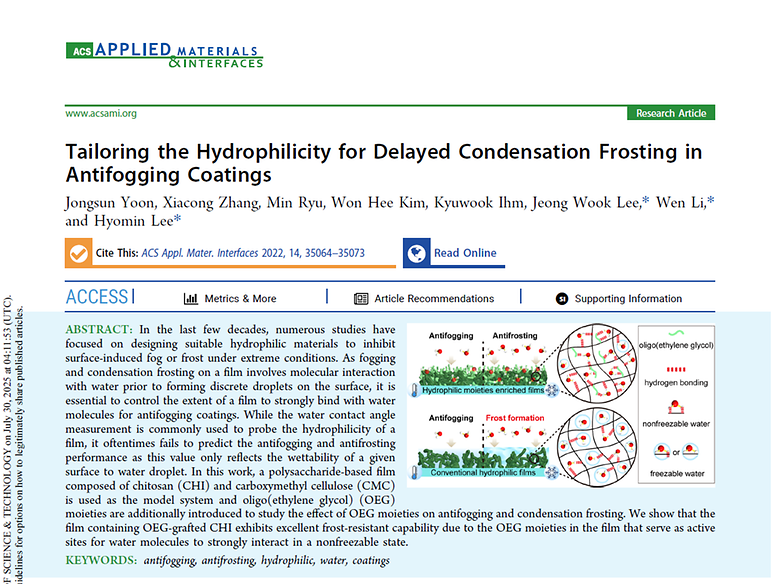
Tailoring the hydrophilicity for delayed condensation frosting in antifogging coatings (ACS Applied Materials & Interfaces, 2022)
In the last few decades, numerous studies have focused on designing suitable hydrophilic materials to inhibit surface-induced fog or frost under extreme conditions. As fogging and condensation frosting on a film involves molecular interaction with water prior to forming discrete droplets on the surface, it is essential to control the extent of a film to strongly bind with water molecules for antifogging coatings. While the water contact angle measurement is commonly used to probe the hydrophilicity of a film, it oftentimes fails to predict the antifogging and antifrosting performance as this value only reflects the wettability of a given surface to water droplet. In this work, a polysaccharide-based film composed of chitosan (CHI) and carboxymethyl cellulose (CMC) is used as the model system and oligo(ethylene glycol) (OEG) moieties are additionally introduced to study the effect of OEG moieties on antifogging and condensation frosting. We show that the film containing OEG-grafted CHI exhibits excellent frost-resistant capability due to the OEG moieties in the film that serve as active sites for water molecules to strongly interact in a nonfreezable state. (Journal citation : ACS Appl. Mater. Interfaces, 30(14):35064-35073 (2022))
J. Yoon
X. Zhang
M. Ryu
Won Hee Kim
K. Ihm
Jeong Wook Lee*
W. Li*
H. Li*
-
40
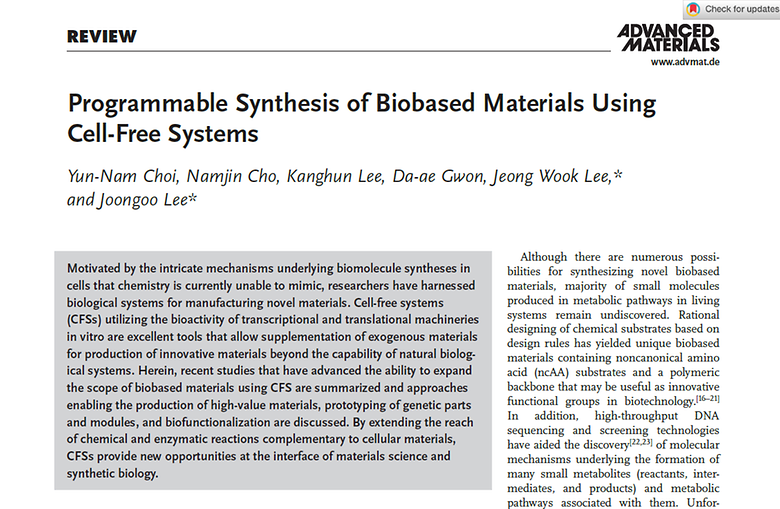
Programmable synthesis of bio-based materials using cell-free systems (Advanced Materials, 2022) (JCR 3%)
Motivated by the intricate mechanisms underlying biomolecule syntheses in cells that chemistry is currently unable to mimic, researchers have harnessed biological systems for manufacturing novel materials. Cell-free systems (CFSs) utilizing the bioactivity of transcriptional and translational machineries in vitro are excellent tools that allow supplementation of exogenous materials for production of innovative materials beyond the capability of natural biological systems. Herein, recent studies that have advanced the ability to expand the scope of biobased materials using CFS are summarized and approaches enabling the production of high-value materials, prototyping of genetic parts and modules, and biofunctionalization are discussed. By extending the reach of chemical and enzymatic reactions complementary to cellular materials, CFSs provide new opportunities at the interface of materials science and synthetic biology. (Journal citation : Adv. Mater. 35(4):2203433 (2022))
Yun-Nam Choi†
N. Cho†
K. Lee
Da-ae Gwon
Jeong Wook Lee*
J. Lee*