-
39
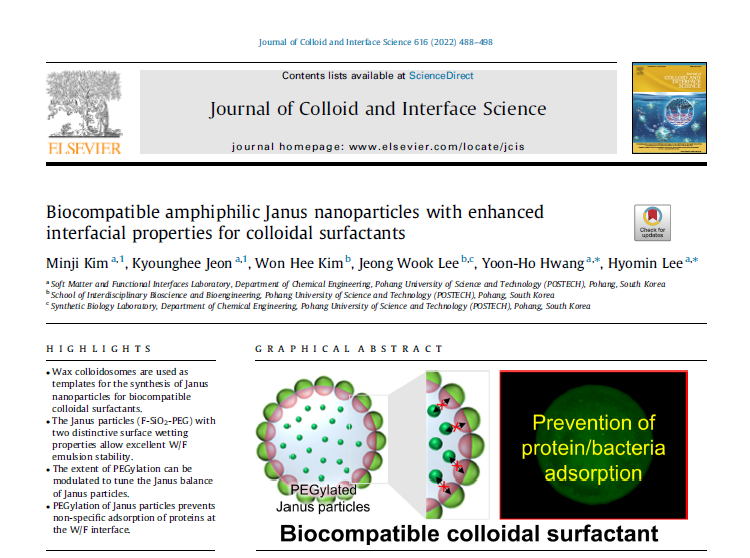
Biocompatible amphiphilic Janus nanoparticles with enhanced interfacial properties for colloidal surfactants (Journal of Colloid and Interface Science, 2022)
Emulsions in which water droplets are dispersed in fluorocarbon oil phase (W/F emulsions) serve as effective means to encapsulate bioactives and precisely execute reactions in confined space due to the gas permeability, chemical inertness, and biocompatibility offered by the continuous phase. While molecular surfactants consisting of perfluorinated polyether (PFPE) and polyethylene glycol (PEG) have been used to stabilize these emulsions, these surfactants cannot effectively prevent coalescence and cross-contamination between the neighboring droplets. Herein, we present Janus nanoparticles (F-SiO2-PEG) as biocompatible colloidal surfactants to achieve excellent stability in W/F emulsions. By utilizing monolayered wax colloidosomes as templates, we show that Janus silica nanoparticles with two distinctive surface wetting properties can be synthesized in high purity. Moreover, we demonstrate that additional PEGylation of these Janus particles allows these colloidal surfactants to strongly adhere at the W/F interface, granting excellent emulsion stability compared to the equivalent randomly functionalized nanoparticles and prevent non-specific adsorption of proteins. As the strategy outlined in this work is general, we anticipate that it can be further extended to prepare Janus particles with tailored interfacial properties for biomedical, cosmetics, and pharmaceutical applications involving emulsions. (Journal citation : J. Colloid Interface Sci., 616: 488-498 (2022))
M. Kim†
K. Jeon†
Won Hee Kim
Jeong Wook Lee
Y.-H. Hwang*
H. Lee*
-
38
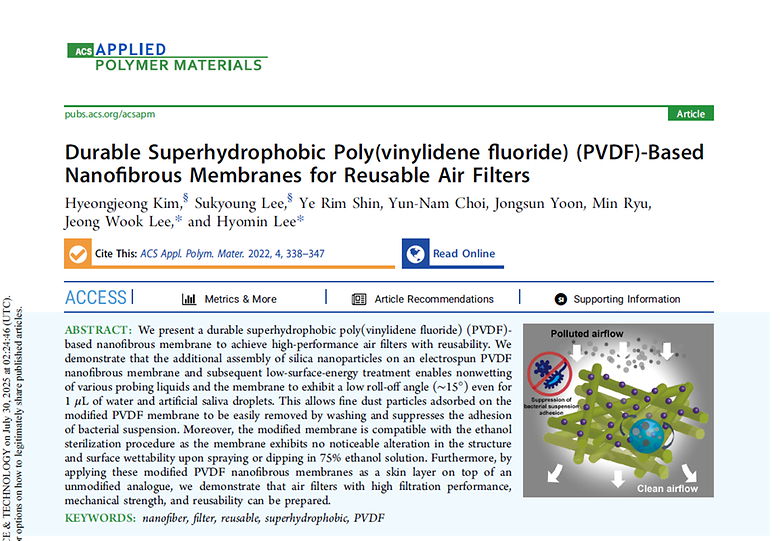
Durable superhydrophobic Poly(vinylidene fluoride) (PVDF)-based nanofibrous membranes for reusable air filters (ACS Applied Polymer Materials, 2022)
We present a durable superhydrophobic poly(vinylidene fluoride) (PVDF)-based nanofibrous membrane to achieve high-performance air filters with reusability. We demonstrate that the additional assembly of silica nanoparticles on an electrospun PVDF nanofibrous membrane and subsequent low-surface-energy treatment enables nonwetting of various probing liquids and the membrane to exhibit a low roll-off angle (∼15°) even for 1 μL of water and artificial saliva droplets. This allows fine dust particles adsorbed on the modified PVDF membrane to be easily removed by washing and suppresses the adhesion of bacterial suspension. Moreover, the modified membrane is compatible with the ethanol sterilization procedure as the membrane exhibits no noticeable alteration in the structure and surface wettability upon spraying or dipping in 75% ethanol solution. Furthermore, by applying these modified PVDF nanofibrous membranes as a skin layer on top of an unmodified analogue, we demonstrate that air filters with high filtration performance, mechanical strength, and reusability can be prepared. (Journal citation : ACS Appl. Polym. Mater., 4(1): 338-347 (2022))
H. Kim†
S. Lee†
Yun-Nam Choi
Ye Rim Shin
J. Yoon
M. Ryu
Jeong Wook Lee*
H. Lee
-
37
Biosensor-Assisted Adaptive Laboratory Evolution for Violacein Production (International Journal of Molecular Sciences, 2021)
Violacein is a naturally occurring purple pigment, widely used in cosmetics and has potent antibacterial and antiviral properties. Violacein can be produced from tryptophan, consequently sufficient tryptophan biosynthesis is the key to violacein production. However, the complicated biosynthetic pathways and regulatory mechanisms often make the tryptophan overproduction challenging in Escherichia coli. In this study, we used the adaptive laboratory evolution (ALE) strategy to improve violacein production using galactose as a carbon source. During the ALE, a tryptophan-responsive biosensor was employed to provide selection pressure to enrich tryptophan-producing cells. From the biosensor-assisted ALE, we obtained an evolved population of cells capable of effectively catabolizing galactose to tryptophan and subsequently used the population to obtain the best violacein producer. In addition, whole-genome sequencing of the evolved strain identified point mutations beneficial to the overproduction. Overall, we demonstrated that the biosensor-assisted ALE strategy could be used to rapidly and selectively evolve the producers to yield high violacein production. (Journal citation : Int. J. Mol. Sci., 22(12): 6594 (2021).)
Da-ae Gwon†
J.Y. Seok†
G.Y. Jung
Jeong Wook Lee*
-
36
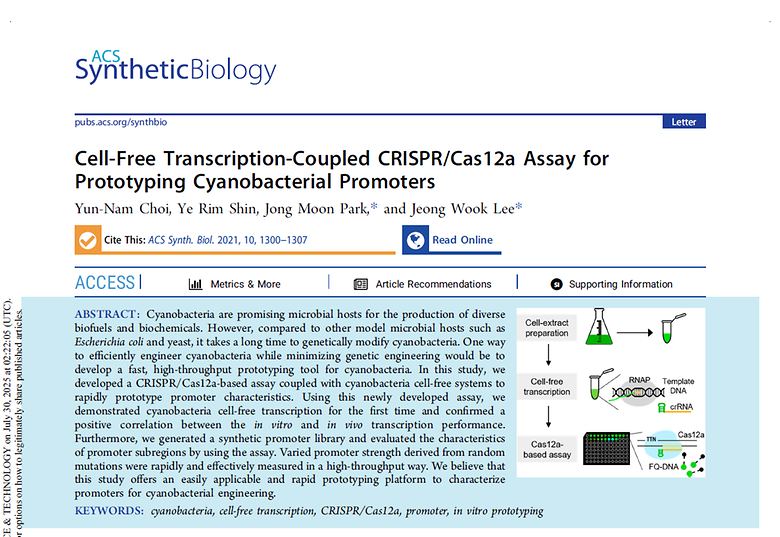
Cell-free transcription-coupled CRISPR/Cas12a assay for prototyping cyanobacterial promoters (ACS Synthetic Biology, 2021)
Cyanobacteria are promising microbial hosts for the production of diverse biofuels and biochemicals. However, compared to other model microbial hosts such as Escherichia coli and yeast, it takes a long time to genetically modify cyanobacteria. One way to efficiently engineer cyanobacteria while minimizing genetic engineering would be to develop a fast, high-throughput prototyping tool for cyanobacteria. In this study, we developed a CRISPR/Cas12a-based assay coupled with cyanobacteria cell-free systems to rapidly prototype promoter characteristics. Using this newly developed assay, we demonstrated cyanobacteria cell-free transcription for the first time and confirmed a positive correlation between the in vitro and in vivo transcription performance. Furthermore, we generated a synthetic promoter library and evaluated the characteristics of promoter subregions by using the assay. Varied promoter strength derived from random mutations were rapidly and effectively measured in a high-throughput way. We believe that this study offers an easily applicable and rapid prototyping platform to characterize promoters for cyanobacterial engineering. (Journal citation : ACS Synth. Biol., 10(6): 1300-1307 (2021))
Yun-Nam Choi
Ye Rim Shin
J.M. Park*
Jeong Wook Lee*
-
35
Cooperative sequence clustering and decoding for DNA storage system with fountain codes (Bioinformatics, 2021) (JCR 10%)
For DNA storage systems using fountain code and Reed-Solomon (RS) code, we introduce several techniques to improve the decoding performance. We designed the decoding process focusing on the cooperation of key components: Hamming-distance based clustering, discarding of abnormal sequence reads, RS error correction as well as detection and quality score-based ordering of sequences. We synthesized 513.6 KB data into DNA oligo pools and sequenced this data successfully with Illumina MiSeq instrument. Compared to Erlich’s research, the proposed decoding method additionally incorporates sequence reads with minor errors which had been discarded before, and thus was able to make use of 10.6–11.9% more sequence reads from the same sequencing environment, this resulted in 6.5–8.9% reduction in the reading cost. Channel characteristics including sequence coverage and read-length distributions are provided as well. (Journal citation : Bioinformatics, 37(19): 3136-3143)
J. Jeong
S.-J. Park
J.-W. Kim
J.-S. No
Ha Hyeon Jeon
Jeong Wook Lee*
A. No
S. Kim
H. Park*
-
34
Detection of coronaviruses using RNA toehold switch sensors (International Journal of Molecular Sciences, 2021)
A rapid, sensitive and simple point-of-care (POC) nucleic acid diagnostic test is needed to prevent spread of infectious diseases. Paper-based toehold reaction, a recently emerged colorimetric POC nucleic acid diagnostic test, has been widely used for pathogen detection and microbiome profiling. Here, we introduce an amplification method called reverse transcription loop-mediated amplification (RT-LAMP) prior to the toehold reaction and modify it to enable more sensitive and faster colorimetric detection of RNA viruses. We show that incorporating the modified RT-LAMP to the toehold reaction detects as few as 120 copies of coronavirus RNA in 70 min. Cross-reactivity test against other coronaviruses indicates this toehold reaction with the modified RT-LAMP is highly specific to the target RNA. Overall, the paper-based toehold switch sensors with the modified RT-LAMP allow fast, sensitive, specific and colorimetric coronavirus detection. (Journal citation : Int. J. Mol. Sci., 22(4): 1772 (2021))
Soan Park
Jeong Wook Lee*
-
33
Sensitive fluorescence detection of SARS-CoV-2 RNA in clinical samples via one-pot isothermal ligation and transcription (Nature Biomedical Engineering, 2020) (JCR 2%)
The control of viral outbreaks requires nucleic acid diagnostic tests that are sensitive, simple and fast. Here, we report a highly sensitive and specific one-pot assay for the fluorescence-based detection of RNA from pathogens. The assay, which can be performed within 30–50 min of incubation time and can reach a limit of detection of 0.1-attomolar RNA concentration, relies on a sustained isothermal reaction cascade producing an RNA aptamer that binds to a fluorogenic dye. The RNA aptamer is transcribed by the T7 RNA polymerase from the ligation product of a promoter DNA probe and a reporter DNA probe that hybridize with the target single-stranded RNA sequence via the SplintR ligase (a Chlorella virus DNA ligase). In 40 nasopharyngeal SARS-CoV-2 samples, the assay reached positive and negative predictive values of 95 and 100%, respectively. We also show that the assay can rapidly detect a range of viral and bacterial RNAs. (Journal citation : Nat. Biomed. Eng., 4:1168-1179 (2020))
Chang Ha Woo†
S. Jang†
G. Shin
G.Y. Jung*
Jeong Wook Lee*
-
32
Cell-free bionsensors for rapid detection of water contaminants (Nature Biotechnology, 2020) (JCR 1%)
Lack of access to safe drinking water is a global problem, and methods to reliably and easily detect contaminants could be transformative. We report the development of a cell-free in vitro transcription system that uses RNA Output Sensors Activated by Ligand Induction (ROSALIND) to detect contaminants in water. A combination of highly processive RNA polymerases, allosteric protein transcription factors and synthetic DNA transcription templates regulates the synthesis of a fluorescence-activating RNA aptamer. The presence of a target contaminant induces the transcription of the aptamer, and a fluorescent signal is produced. We apply ROSALIND to detect a range of water contaminants, including antibiotics, small molecules and metals. We also show that adding RNA circuitry can invert responses, reduce crosstalk and improve sensitivity without protein engineering. The ROSALIND system can be freeze-dried for easy storage and distribution, and we apply it in the field to test municipal water supplies, demonstrating its potential use for monitoring water quality. (Journal citation : Nat. Biotechnol., 38:1451-1459 (2020))
J.K. Jung
K.K. Alam
M.S. Verosloff
D.A. Capdevila
M. Desmau
P.R. Clauer
Jeong Wook Lee
P.Q. Nguyen
P.A. Pastén
S.K. Matiasek
J.-F. Gaillard
D.P. Giedroc
J.J. Collins
J.B. Lucks
-
31
Genetic Biocontainment Systems for the Safe Use of Engineered Microorganisms (Biotechnology and Bioprocess Engineering, 2020)
Recent advances in genetic engineering and synthetic biology have enabled a variety of genetically modified microorganisms (GMOs) designed for open environmental applications. The use of GMOs in these applications, however, raised concerns about the spread of artificial biological matters into the natural environment. To address the issue, genetic biocontainment system has emerged as a way to prevent unauthorized propagation of GMOs and genetic materials into the ecosystem. In this review, we introduce biocontainment systems that control the proliferation of microorganisms and the release of genetic materials, focusing primarily on genetic means to eliminate cells and DNA. We outline each biocontainment system with representative examples, highlighting its advantages and disadvantages. We also discuss future challenges that genetic biocontainment systems should overcome for practical uses. (Journal citation : Biotechnol. Bioproc. E., 25:974-984 (2020))
Donghyeon Kim
Jeong Wook Lee*
-
30
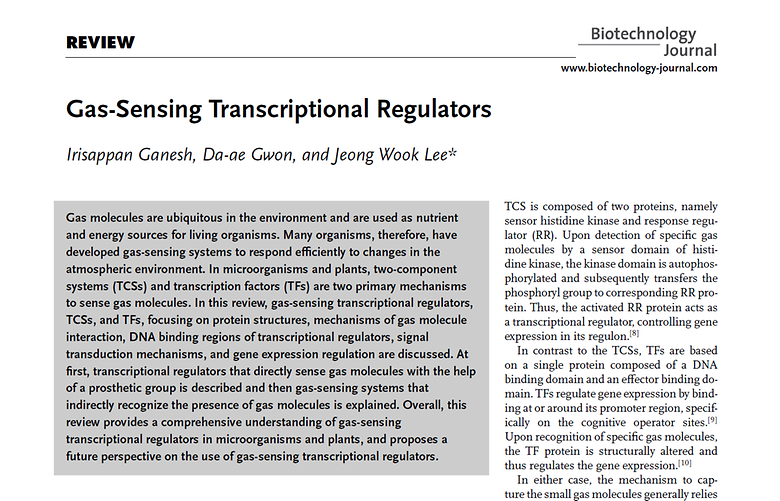
Gas-sensing transcriptional regulators (Biotechnology Journal, 2020)
Gas molecules are ubiquitous in the environment and are used as nutrient and energy sources for living organisms. Many organisms, therefore, have developed gas-sensing systems to respond efficiently to changes in the atmospheric environment. In microorganisms and plants, two-component systems (TCSs) and transcription factors (TFs) are two primary mechanisms to sense gas molecules. In this review, gas-sensing transcriptional regulators, TCSs, and TFs, focusing on protein structures, mechanisms of gas molecule interaction, DNA binding regions of transcriptional regulators, signal transduction mechanisms, and gene expression regulation are discussed. At first, transcriptional regulators that directly sense gas molecules with the help of a prosthetic group is described and then gas-sensing systems that indirectly recognize the presence of gas molecules is explained. Overall, this review provides a comprehensive understanding of gas-sensing transcriptional regulators in microorganisms and plants, and proposes a future perspective on the use of gas-sensing transcriptional regulators. (Journal citation : Biotech. J., 15,1900345 (2020))
Irisappan Ganesh
Da-ae Gwon
Jeong Wook Lee*