-
29
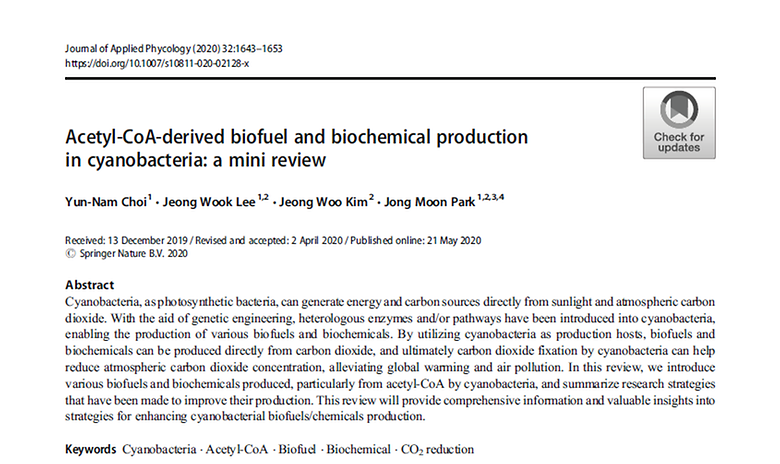
Acetyl-CoA-derived biofuel and biochemical production in cyanobacteria: a mini review (Journal of Applied Phycology, 2020)
Cyanobacteria, as photosynthetic bacteria, can generate energy and carbon sources directly from sunlight and atmospheric carbon dioxide. With the aid of genetic engineering, heterologous enzymes and/or pathways have been introduced into cyanobacteria, enabling the production of various biofuels and biochemicals. By utilizing cyanobacteria as production hosts, biofuels and biochemicals can be produced directly from carbon dioxide, and ultimately carbon dioxide fixation by cyanobacteria can help reduce atmospheric carbon dioxide concentration, alleviating global warming and air pollution. In this review, we introduce various biofuels and biochemicals produced, particularly from acetyl-CoA by cyanobacteria, and summarize research strategies that have been made to improve their production. This review will provide comprehensive information and valuable insights into strategies for enhancing cyanobacterial biofuels/chemicals production. (Journal citation : J. Appl. Phycol., 32:1643-1653 (2020))
Yun-Nam Choi
Jeong Wook Lee
J.W. Kim
J.M. Park
-
28
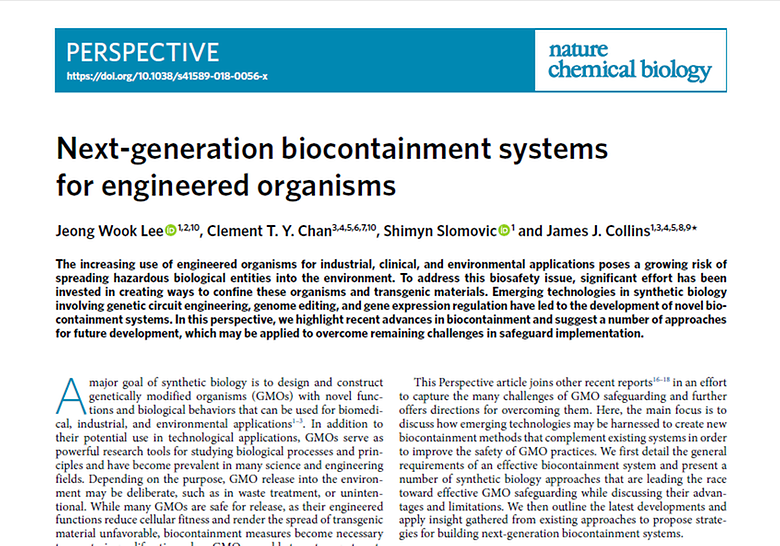
Next-generation biocontainment systems for engineered organisms (Nature Chemical Biology, 2018) (JCR 5%)
The increasing use of engineered organisms for industrial, clinical, and environmental applications poses a growing risk of spreading hazardous biological entities into the environment. To address this biosafety issue, significant effort has been invested in creating ways to confine these organisms and transgenic materials. Emerging technologies in synthetic biology involving genetic circuit engineering, genome editing, and gene expression regulation have led to the development of novel biocontainment systems. In this perspective, we highlight recent advances in biocontainment and suggest a number of approaches for future development, which may be applied to overcome remaining challenges in safeguard implementation. (Nat. Chem. Biol., 14:530-537 (2018))
Jeong Wook Lee†
C.T.Y. Chan†
S. Slomovic
J.J. Colllins
-
27
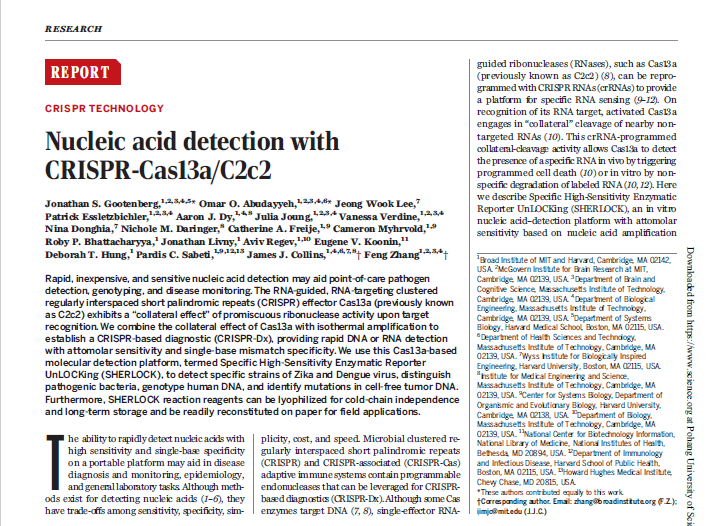
Nucleic acid detection with CRISPR-Cas13a/C2c2 (Science, 2017) (JCR 2%)
Rapid, inexpensive, and sensitive nucleic acid detection may aid point-of-care pathogen detection, genotyping, and disease monitoring. The RNA-guided, RNA-targeting clustered regularly interspaced short palindromic repeats (CRISPR) effector Cas13a (previously known as C2c2) exhibits a “collateral effect” of promiscuous ribonuclease activity upon target recognition. We combine the collateral effect of Cas13a with isothermal amplification to establish a CRISPR-based diagnostic (CRISPR-Dx), providing rapid DNA or RNA detection with attomolar sensitivity and single-base mismatch specificity. We use this Cas13a-based molecular detection platform, termed Specific High-Sensitivity Enzymatic Reporter UnLOCKing (SHERLOCK), to detect specific strains of Zika and Dengue virus, distinguish pathogenic bacteria, genotype human DNA, and identify mutations in cell-free tumor DNA. Furthermore, SHERLOCK reaction reagents can be lyophilized for cold-chain independence and long-term storage and be readily reconstituted on paper for field applications. (Journal citation : Science, 356(6336): 438-442 (2017))
J.S. Gootenberg
O.O. Abudayyeh
Jeong Wook Lee
P. Essletzbichler
A. Dy
J. Joung
V. Verdine
N. Donghia
N.M. Daringer
C.A. Freije
C. Myhrvold
R.P. Bhattacharyya
J. Livny
A. Regev
E.V. Koonin
D.T. Hung
P.C. Sabeti
J.J. Collins
F. Zhang
-
26
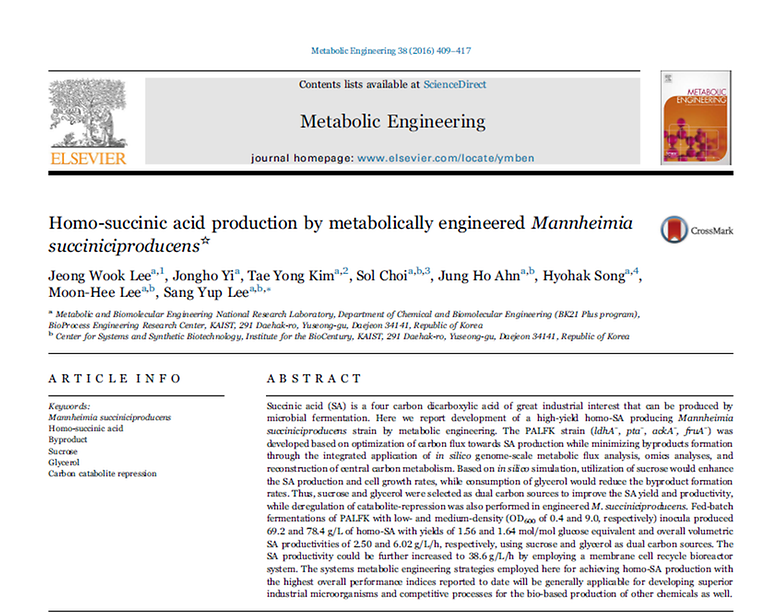
Homo-succinic acid production by metabolically engineered Mannheimia succiniciproducens (Metabolic Engineering, 2016) (JCR 10%)
Succinic acid (SA) is a four carbon dicarboxylic acid of great industrial interest that can be produced by microbial fermentation. Here we report development of a high-yield homo-SA producing Mannheimia succiniciproducens strain by metabolic engineering. The PALFK strain (ldhA-, pta-, ackA-, fruA-) was developed based on optimization of carbon flux towards SA production while minimizing byproducts formation through the integrated application of in silico genome-scale metabolic flux analysis, omics analyses, and reconstruction of central carbon metabolism. Based on in silico simulation, utilization of sucrose would enhance the SA production and cell growth rates, while consumption of glycerol would reduce the byproduct formation rates. Thus, sucrose and glycerol were selected as dual carbon sources to improve the SA yield and productivity, while deregulation of catabolite-repression was also performed in engineered M. succiniciproducens. Fed-batch fermentations of PALFK with low- and medium-density (OD600 of 0.4 and 9.0, respectively) inocula produced 69.2 and 78.4 g/L of homo-SA with yields of 1.56 and 1.64 mol/mol glucose equivalent and overall volumetric SA productivities of 2.50 and 6.02 g/L/h, respectively, using sucrose and glycerol as dual carbon sources. The SA productivity could be further increased to 38.6 g/L/h by employing a membrane cell recycle bioreactor system. The systems metabolic engineering strategies employed here for achieving homo-SA production with the highest overall performance indices reported to date will be generally applicable for developing superior industrial microorganisms and competitive processes for the bio-based production of other chemicals as well. (Journal citation : Metab. Eng., 38: 409-417 (2016))
Jeong Wook Lee
J. Yi
T.Y. Kim
S. Choi
J.H. Ahn
H. Song
M.-H. Lee
S.Y. Lee
-
25
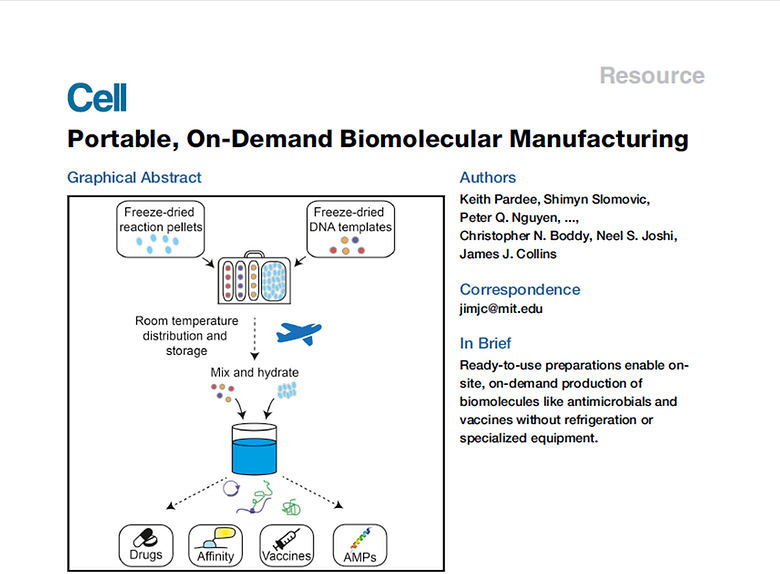
Portable, On-demand Biomolecular Manufacturing (Cell, 2016) (JCR 1%)
Synthetic biology uses living cells as molecular foundries for the biosynthesis of drugs, therapeutic proteins, and other commodities. However, the need for specialized equipment and refrigeration for production and distribution poses a challenge for the delivery of these technologies to the field and to low-resource areas. Here, we present a portable platform that provides the means for on-site, on-demand manufacturing of therapeutics and biomolecules. This flexible system is based on reaction pellets composed of freeze-dried, cell-free transcription and translation machinery, which can be easily hydrated and utilized for biosynthesis through the addition of DNA encoding the desired output. We demonstrate this approach with the manufacture and functional validation of antimicrobial peptides and vaccines and present combinatorial methods for the production of antibody conjugates and small molecules. This synthetic biology platform resolves important practical limitations in the production and distribution of therapeutics and molecular tools, both to the developed and developing world. (Journal citation : Cell, 167(1): 248-259 (2016).
K. Pardee†
S. Slomovic†
P.Q. Nguyen†
Jeong Wook Lee†
N. Donghia
D. Burrill
T. Ferrante
F. McSorley
Y. Furuta
A. Vernet
M. Lewandowski
C.N. Boddy
N.S. Joshi
J.J. Collins
-
24
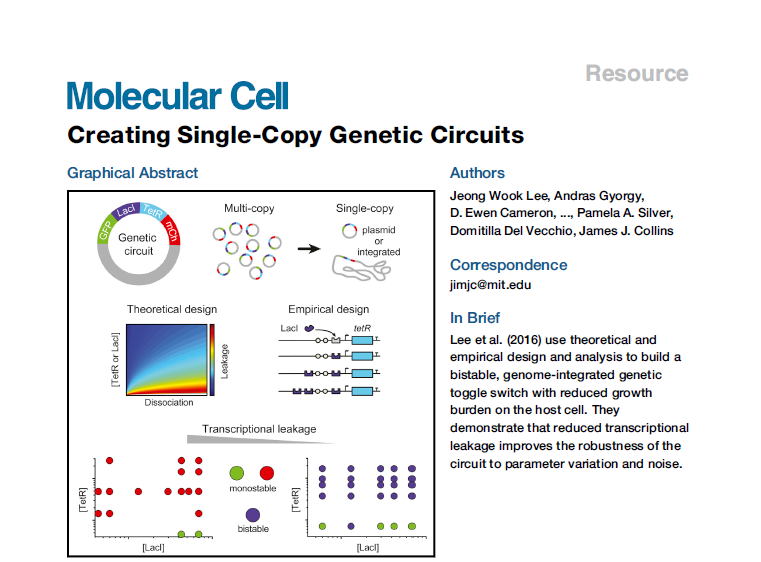
Creating single-copy genetic circuits (Molecular Cell, 2016) (JCR 2%)
Synthetic biology is increasingly used to develop sophisticated living devices for basic and applied research. Many of these genetic devices are engineered using multi-copy plasmids, but as the field progresses from proof-of-principle demonstrations to practical applications, it is important to develop single-copy synthetic modules that minimize consumption of cellular resources and can be stably maintained as genomic integrants. Here we use empirical design, mathematical modeling, and iterative construction and testing to build single-copy, bistable toggle switches with improved performance and reduced metabolic load that can be stably integrated into the host genome. Deterministic and stochastic models led us to focus on basal transcription to optimize circuit performance and helped to explain the resulting circuit robustness across a large range of component expression levels. The design parameters developed here provide important guidance for future efforts to convert functional multi-copy gene circuits into optimized single-copy circuits for practical, real-world use. (Journal citation : Mol. Cell, 63: 329-336 (2016))
Jeong Wook Lee
A. Gyorgy
D.E. Cameron
N. Pyenson
K.R. Choi
J.C. Way
P.A. Silver
D. Del Vecchio
-
23
Rapid, low-cost detection of Zika virus using programmable biomolecular components (Cell, 2016) (JCR 1%)
The recent Zika virus outbreak highlights the need for low-cost diagnostics that can be rapidly developed for distribution and use in pandemic regions. Here, we report a pipeline for the rapid design, assembly, and validation of cell-free, paper-based sensors for the detection of the Zika virus RNA genome. By linking isothermal RNA amplification to toehold switch RNA sensors, we detect clinically relevant concentrations of Zika virus sequences and demonstrate specificity against closely related Dengue virus sequences. When coupled with a novel CRISPR/Cas9-based module, our sensors can discriminate between viral strains with single-base resolution. We successfully demonstrate a simple, field-ready sample-processing workflow and detect Zika virus from the plasma of a viremic macaque. Our freeze-dried biomolecular platform resolves important practical limitations to the deployment of molecular diagnostics in the field and demonstrates how synthetic biology can be used to develop diagnostic tools for confronting global health crises. (Journal citation : Cell, 165(5):1255-1266 (2016))
K. Pardee
A.A. Green
M.K. Takahashi
D. Braff
G. Lambert
Jeong Wook Lee
T. Ferrante
D. Ma
N. Donghia
M. Fan
N.M. Daringer
I. Bosch
D.M. Dudley
D.H. O'Connor
L. Gehrke
J.J. Collins
-
22
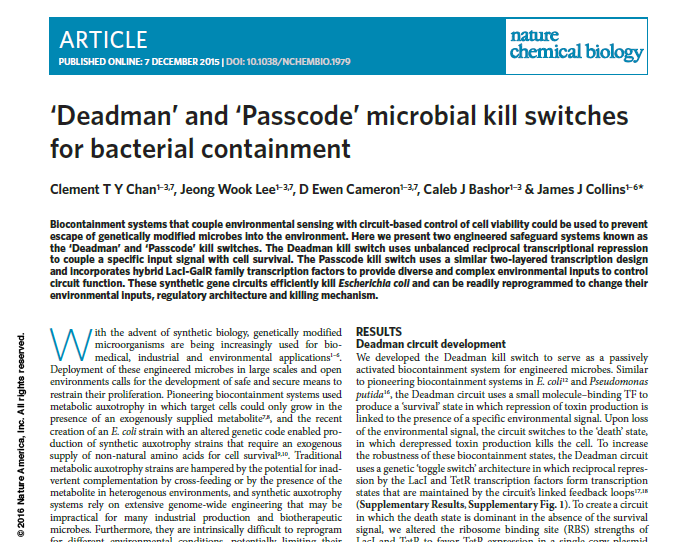
Deadman and Passcode microbial kill switches for bacterial containment (Nature Chemical Biology, 2016) (JCR 5%)
Biocontainment systems that couple environmental sensing with circuit-based control of cell viability could be used to prevent escape of genetically modified microbes into the environment. Here we present two engineered safeguard systems known as the 'Deadman' and 'Passcode' kill switches. The Deadman kill switch uses unbalanced reciprocal transcriptional repression to couple a specific input signal with cell survival. The Passcode kill switch uses a similar two-layered transcription design and incorporates hybrid LacI-GalR family transcription factors to provide diverse and complex environmental inputs to control circuit function. These synthetic gene circuits efficiently kill Escherichia coli and can be readily reprogrammed to change their environmental inputs, regulatory architecture and killing mechanism. (Journal citation : Nat. Chem. Biol., 12:82-86 (2016))
-
21
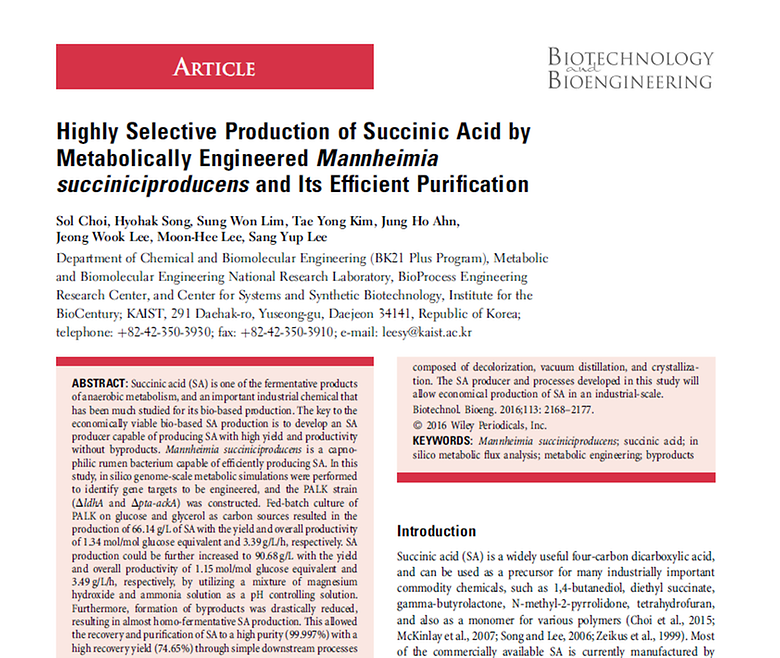
Highly selective production of succinic acid by metabolically engineered Mannheimia succiniciproducensand its efficient purification (Biotechnology and Bioengineering, 2016)
Succinic acid (SA) is one of the fermentative products of anaerobic metabolism, and an important industrial chemical that has been much studied for its bio-based production. The key to the economically viable bio-based SA production is to develop an SA producer capable of producing SA with high yield and productivity without byproducts. Mannheimia succiniciproducens is a capnophilic rumen bacterium capable of efficiently producing SA. In this study, in silico genome-scale metabolic simulations were performed to identify gene targets to be engineered, and the PALK strain (ΔldhA and Δpta-ackA) was constructed. Fed-batch culture of PALK on glucose and glycerol as carbon sources resulted in the production of 66.14 g/L of SA with the yield and overall productivity of 1.34 mol/mol glucose equivalent and 3.39 g/L/h, respectively. SA production could be further increased to 90.68 g/L with the yield and overall productivity of 1.15 mol/mol glucose equivalent and 3.49 g/L/h, respectively, by utilizing a mixture of magnesium hydroxide and ammonia solution as a pH controlling solution. Furthermore, formation of byproducts was drastically reduced, resulting in almost homo-fermentative SA production. This allowed the recovery and purification of SA to a high purity (99.997%) with a high recovery yield (74.65%) through simple downstream processes composed of decolorization, vacuum distillation, and crystallization. The SA producer and processes developed in this study will allow economical production of SA in an industrial-scale. (Journal citation : Biotechnol. Bioeng., 113(10):2168-77 (2016))
S. Choi
H. Song
S.W. Lim
T.Y. Kim
J.H. Ahn
Jeong Wook Lee
M.-H. Lee
S.Y. Lee
-
20
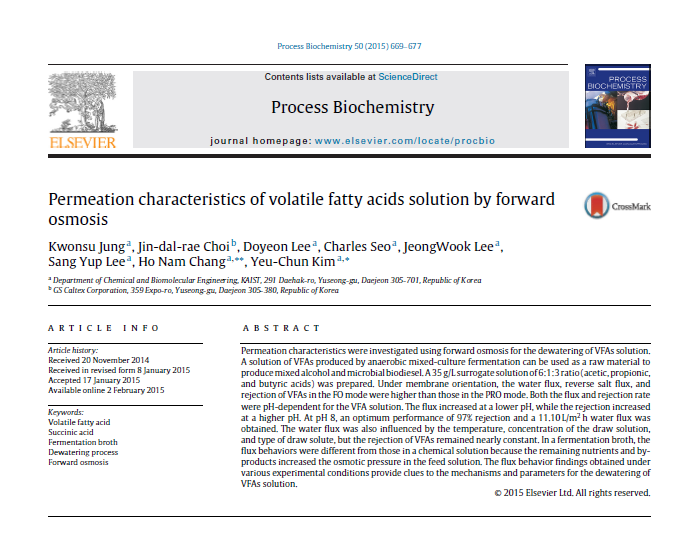
Permeation characteristics of volatile fatty acids solution by forward osmosis (Process Biochemistry, 2015)
Permeation characteristics were investigated using forward osmosis for the dewatering of VFAs solution. A solution of VFAs produced by anaerobic mixed-culture fermentation can be used as a raw material to produce mixed alcohol and microbial biodiesel. A 35 g/L surrogate solution of 6:1:3 ratio (acetic, propionic, and butyric acids) was prepared. Under membrane orientation, the water flux, reverse salt flux, and rejection of VFAs in the FO mode were higher than those in the PRO mode. Both the flux and rejection rate were pH-dependent for the VFA solution. The flux increased at a lower pH, while the rejection increased at a higher pH. At pH 8, an optimum performance of 97% rejection and a 11.10 L/m2 h water flux was obtained. The water flux was also influenced by the temperature, concentration of the draw solution, and type of draw solute, but the rejection of VFAs remained nearly constant. In a fermentation broth, the flux behaviors were different from those in a chemical solution because the remaining nutrients and by-products increased the osmotic pressure in the feed solution. The flux behavior findings obtained under various experimental conditions provide clues to the mechanisms and parameters for the dewatering of VFAs solution. (Journal citation : Process Biochem., 50:669-677 (2015))
K. Jung
J.-D.-R. Choi
D. Lee
C. Seo
Jeong Wook Lee