-
19
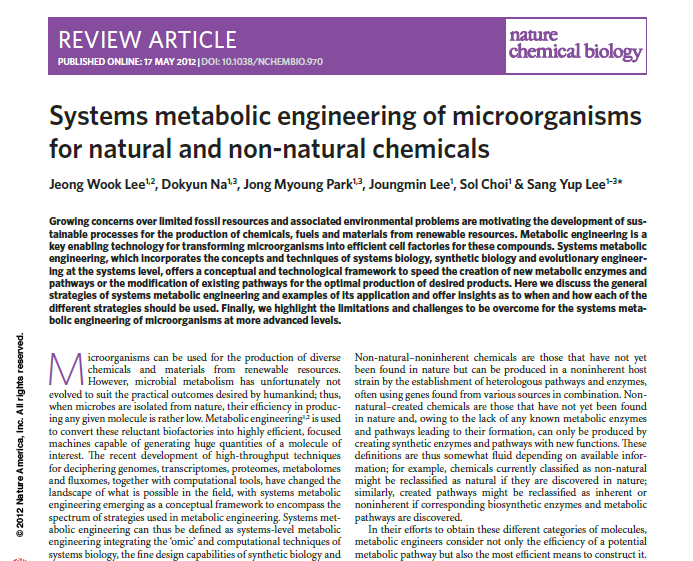
Systems metabolic engineering of microorganisms for natural and nonnatural chemicals (Nature Chemical Biology, 2012) (JCR 5%)
Growing concerns over limited fossil resources and associated environmental problems are motivating the development of sustainable processes for the production of chemicals, fuels and materials from renewable resources. Metabolic engineering is a key enabling technology for transforming microorganisms into efficient cell factories for these compounds. Systems metabolic engineering, which incorporates the concepts and techniques of systems biology, synthetic biology and evolutionary engineering at the systems level, offers a conceptual and technological framework to speed the creation of new metabolic enzymes and pathways or the modification of existing pathways for the optimal production of desired products. Here we discuss the general strategies of systems metabolic engineering and examples of its application and offer insights as to when and how each of the different strategies should be used. Finally, we highlight the limitations and challenges to be overcome for the systems metabolic engineering of microorganisms at more advanced levels. (Journal citation : Nat. Chem. Biol., 8:536-546 (2012))
Jeong Wook Lee
D. Na
J.M. Park
J. Lee
S. Choi
S.Y. Lee
-
18
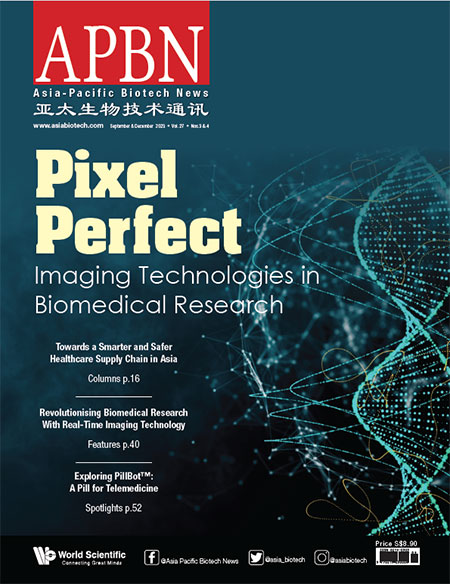
Biorefinery Research in Korea (Asia-Pacific Biotech News, 2011)
(Journal citation : Asia Pacific Biotech. News, 15(12): 15-21 (2011). (Journal cover paper))
S.Y. Lee
S.B. Sohn
J.M. Park
Jeong Wook Lee
-
17
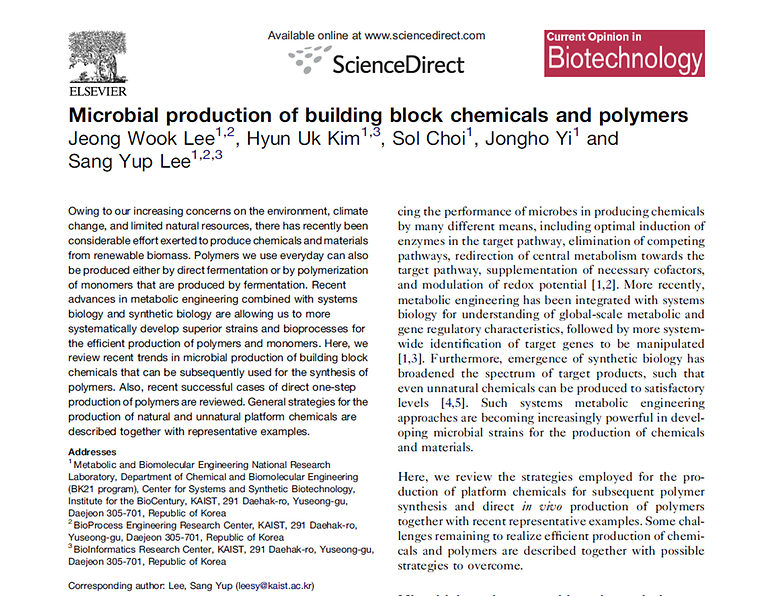
Microbial production of building block chemicals and polymers (Current Opinion in Biotechnology, 2011) (JCR 5%)
Owing to our increasing concerns on the environment, climate change, and limited natural resources, there has recently been considerable effort exerted to produce chemicals and materials from renewable biomass. Polymers we use everyday can also be produced either by direct fermentation or by polymerization of monomers that are produced by fermentation. Recent advances in metabolic engineering combined with systems biology and synthetic biology are allowing us to more systematically develop superior strains and bioprocesses for the efficient production of polymers and monomers. Here, we review recent trends in microbial production of building block chemicals that can be subsequently used for the synthesis of polymers. Also, recent successful cases of direct one-step production of polymers are reviewed. General strategies for the production of natural and unnatural platform chemicals are described together with representative examples. (Journal citation : Curr. Opin. Biotechnol., 22(6):758–767 (2011))
Jeong Wook Lee
H.U. Kim
S. Choi
S.Y. Lee
-
16
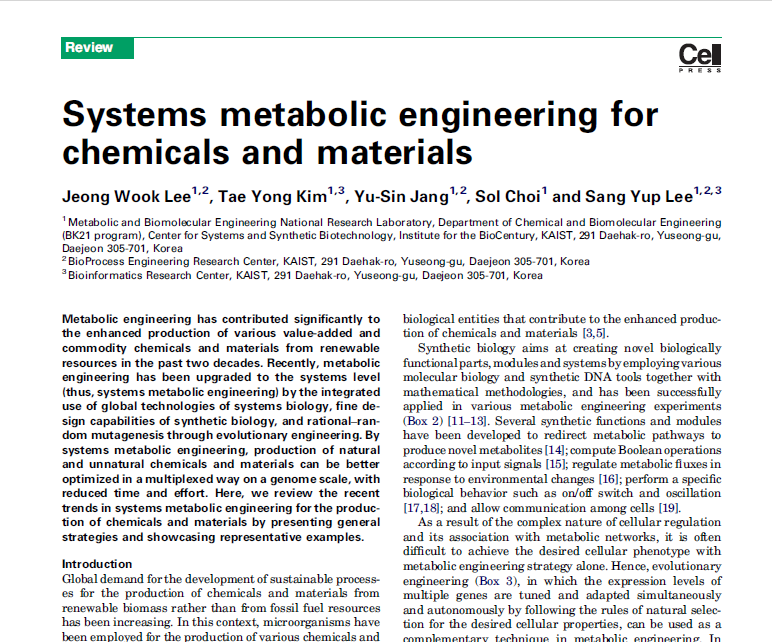
Systems metabolic engineering for chemicals and materials (Trends in Biotechnology, 2011) (JCR 2%)
Metabolic engineering has contributed significantly to the enhanced production of various value-added and commodity chemicals and materials from renewable resources in the past two decades. Recently, metabolic engineering has been upgraded to the systems level (thus, systems metabolic engineering) by the integrated use of global technologies of systems biology, fine design capabilities of synthetic biology, and rational–random mutagenesis through evolutionary engineering. By systems metabolic engineering, production of natural and unnatural chemicals and materials can be better optimized in a multiplexed way on a genome scale, with reduced time and effort. Here, we review the recent trends in systems metabolic engineering for the production of chemicals and materials by presenting general strategies and showcasing representative examples. (Journal citation : Trends Biotechnol., 29(8): 370-378 (2011). (Journal cover paper))
Jeong Wook Lee
T.Y. Kim
Y.S. Jang
S. Choi
-
15
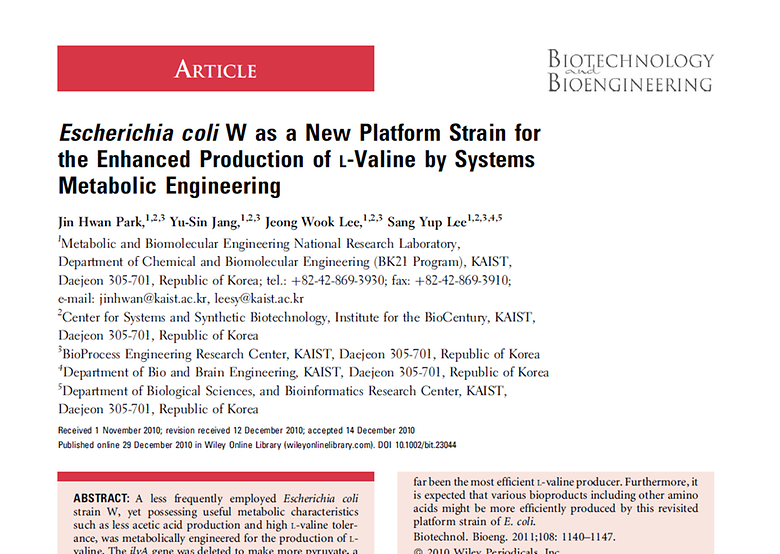
Escherichia coli W as a new platform strain for the enhanced production of L-valine by systems metabolic engineering (Biotechnology and Bioengineering, 2011)
A less frequently employed Escherichia coli strain W, yet possessing useful metabolic characteristics such as less acetic acid production and high L-valine tolerance, was metabolically engineered for the production of L-valine. The ilvA gene was deleted to make more pyruvate, a key precursor for L-valine, available for enhanced L-valine biosynthesis. The lacI gene was deleted to allow constitutive expression of genes under the tac or trc promoter. The ilvBNmut genes encoding feedback-resistant acetohydroxy acid synthase (AHAS) I and the L-valine biosynthetic ilvCED genes encoding acetohydroxy acid isomeroreductase, dihydroxy acid dehydratase, and branched chain amino acid aminotransferase, respectively, were amplified by plasmid-based overexpression. The global regulator Lrp and L-valine exporter YgaZH were also amplified by plasmid-based overexpression. The engineered E. coli W (ΔlacI ΔilvA) strain overexpressing the ilvBNmut, ilvCED, ygaZH, and lrp genes was able to produce an impressively high concentration of 60.7 g/L L-valine by fed-batch culture in 29.5 h, resulting in a high volumetric productivity of 2.06 g/L/h. The most notable finding is that there was no other byproduct produced during L-valine production. The results obtained in this study suggest that E. coli W can be a good alternative to Corynebacterium glutamicum and E. coli K-12, which have so far been the most efficient L-valine producer. Furthermore, it is expected that various bioproducts including other amino acids might be more efficiently produced by this revisited platform strain of E. coli. (Journal citation : Biotechnol. Bioeng., 108(5):1140-1147 (2011))
J.H. Park
Y.S. Jang
Jeong Wook Lee
S.Y. Lee
-
14
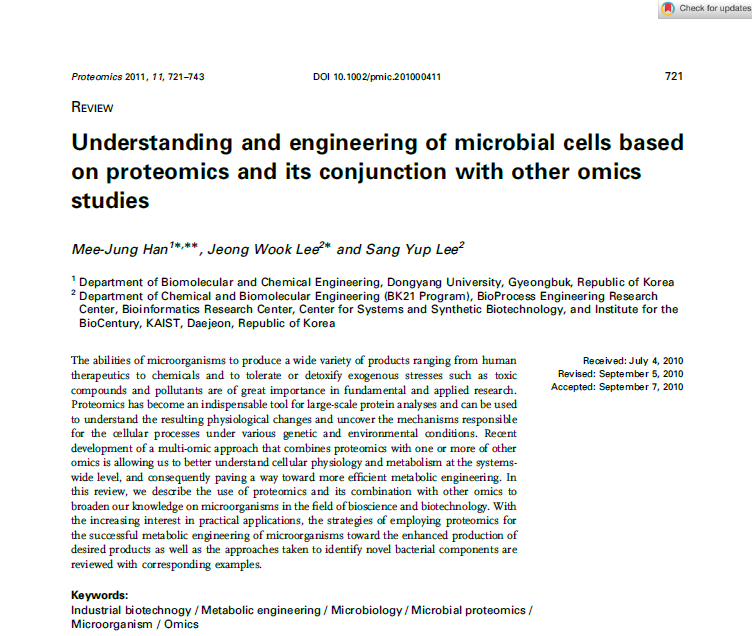
Understanding and engineering microbial cells based on proteomics and its combined analyses (Proteomics, 2011)
The abilities of microorganisms to produce a wide variety of products ranging from human therapeutics to chemicals and to tolerate or detoxify exogenous stresses such as toxic compounds and pollutants are of great importance in fundamental and applied research. Proteomics has become an indispensable tool for large-scale protein analyses and can be used to understand the resulting physiological changes and uncover the mechanisms responsible for the cellular processes under various genetic and environmental conditions. Recent development of a multi-omic approach that combines proteomics with one or more of other omics is allowing us to better understand cellular physiology and metabolism at the systems-wide level, and consequently paving a way toward more efficient metabolic engineering. In this review, we describe the use of proteomics and its combination with other omics to broaden our knowledge on microorganisms in the field of bioscience and biotechnology. With the increasing interest in practical applications, the strategies of employing proteomics for the successful metabolic engineering of microorganisms toward the enhanced production of desired products as well as the approaches taken to identify novel bacterial components are reviewed with corresponding examples. (Journal citation : Proteomics, 11(4): 721-743 (2011))
M.-J. Han†
Jeong Wook Lee†
S.Y. Lee
-
13
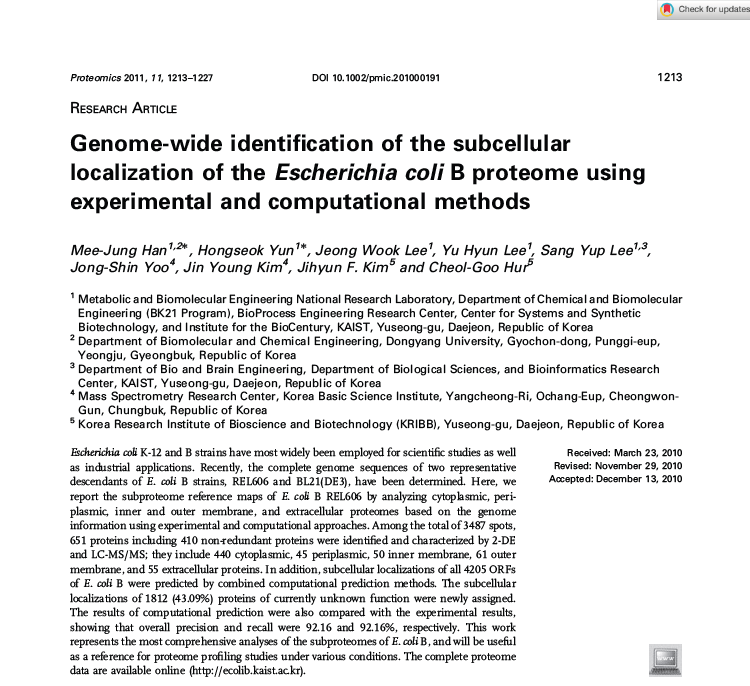
Genome-wide identification of the subcellular localization of the Escherichia coli B proteome using experimental and computational methods (Proteomics, 2011)
Escherichia coli K-12 and B strains have most widely been employed for scientific studies as well as industrial applications. Recently, the complete genome sequences of two representative descendants of E. coli B strains, REL606 and BL21(DE3), have been determined. Here, we report the subproteome reference maps of E. coli B REL606 by analyzing cytoplasmic, periplasmic, inner and outer membrane, and extracellular proteomes based on the genome information using experimental and computational approaches. Among the total of 3487 spots, 651 proteins including 410 non-redundant proteins were identified and characterized by 2-DE and LC-MS/MS; they include 440 cytoplasmic, 45 periplasmic, 50 inner membrane, 61 outer membrane, and 55 extracellular proteins. In addition, subcellular localizations of all 4205 ORFs of E. coli B were predicted by combined computational prediction methods. The subcellular localizations of 1812 (43.09%) proteins of currently unknown function were newly assigned. The results of computational prediction were also compared with the experimental results, showing that overall precision and recall were 92.16 and 92.16%, respectively. This work represents the most comprehensive analyses of the subproteomes of E. coli B, and will be useful as a reference for proteome profiling studies under various conditions. (Journal citation : Proteomics, 11(7): 1213-1227 (2011))
M.-J. Han
H. Yun
Jeong Wook Lee
Y.H. Lee
S.Y. Lee
J.-S. Yoo
J.Y. Kim
J.F. Kim
C.-G. Hur
-
12
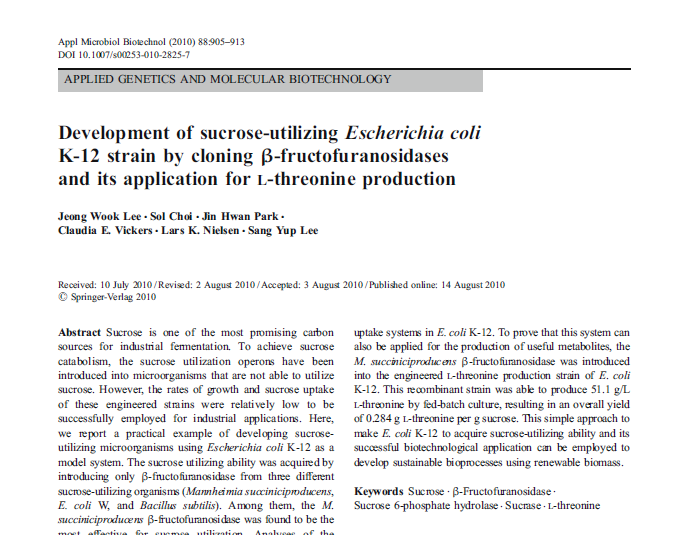
Development of sucrose-utilizing Escherichia coli K-12 strain by cloning β-fructofuranosidases and its application for L-threonine production (Applied Microbiology and Biotechnology, 2010)
Sucrose is one of the most promising carbon sources for industrial fermentation. To achieve sucrose catabolism, the sucrose utilization operons have been introduced into microorganisms that are not able to utilize sucrose. However, the rates of growth and sucrose uptake of these engineered strains were relatively low to be successfully employed for industrial applications. Here, we report a practical example of developing sucrose-utilizing microorganisms using Escherichia coli K-12 as a model system. The sucrose utilizing ability was acquired by introducing only β-fructofuranosidase from three different sucrose-utilizing organisms (Mannheimia succiniciproducens, E. coli W, and Bacillus subtilis). Among them, the M. succiniciproducens β-fructofuranosidase was found to be the most effective for sucrose utilization. Analyses of the underlying mechanism revealed that sucrose was hydrolyzed into glucose and fructose in the extracellular space and both liberated hexoses could be transported by their respective uptake systems in E. coli K-12. To prove that this system can also be applied for the production of useful metabolites, the M. succiniciproducens β-fructofuranosidase was introduced into the engineered l-threonine production strain of E. coli K-12. This recombinant strain was able to produce 51.1 g/L l-threonine by fed-batch culture, resulting in an overall yield of 0.284 g l-threonine per g sucrose. This simple approach to make E. coli K-12 to acquire sucrose-utilizing ability and its successful biotechnological application can be employed to develop sustainable bioprocesses using renewable biomass. (Journal citation : Appl. Microbiol. Biotechnol., 88(4): 905-913 (2010))
Jeong Wook Lee
S. Choi
J.H. Park
C. Vickers
L.K. Nielsen
S.Y. Lee
-
11
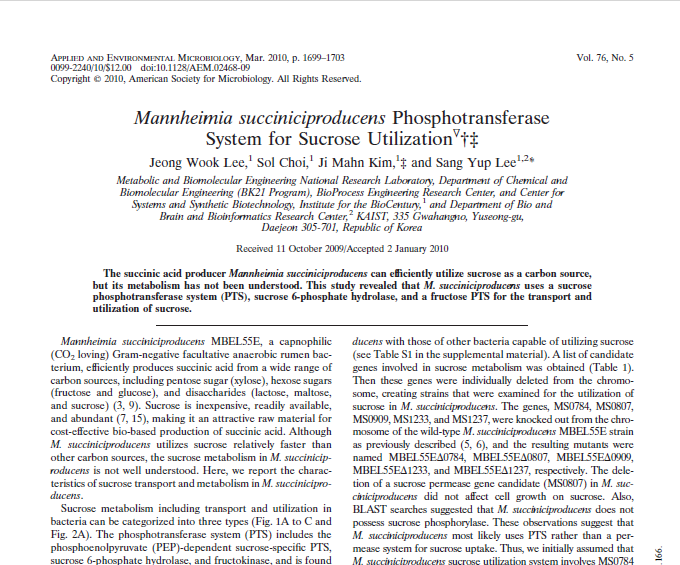
Mannheimia succiniciproducens phosphotransferase system for sucrose utilization (Applied and Environmental Microbiology, 2010))
The succinic acid producer Mannheimia succiniciproducens can efficiently utilize sucrose as a carbon source, but its metabolism has not been understood. This study revealed that M. succiniciproducens uses a sucrose phosphotransferase system (PTS), sucrose 6-phosphate hydrolase, and a fructose PTS for the transport and utilization of sucrose (Journal citation : Appl. Environ. Microbiol., 76(5): 1699-1703 (2010))
Jeong Wook Lee
S. Choi
S.Y. Lee
-
10
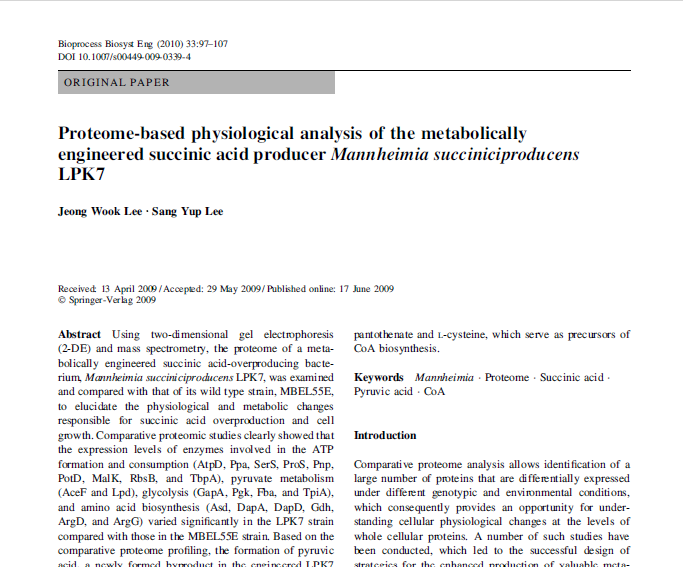
Proteome-based physiological analysis of the metabolically engineered succinic acid producer Mannheimia succiniciproducens LPK7 (Bioprocess and Biosystems Engineering, 2010)
Using two-dimensional gel electrophoresis (2-DE) and mass spectrometry, the proteome of a metabolically engineered succinic acid-overproducing bacterium, Mannheimia succiniciproducens LPK7, was examined and compared with that of its wild type strain, MBEL55E, to elucidate the physiological and metabolic changes responsible for succinic acid overproduction and cell growth. Comparative proteomic studies clearly showed that the expression levels of enzymes involved in the ATP formation and consumption (AtpD, Ppa, SerS, ProS, Pnp, PotD, MalK, RbsB, and TbpA), pyruvate metabolism (AceF and Lpd), glycolysis (GapA, Pgk, Fba, and TpiA), and amino acid biosynthesis (Asd, DapA, DapD, Gdh, ArgD, and ArgG) varied significantly in the LPK7 strain compared with those in the MBEL55E strain. Based on the comparative proteome profiling, the formation of pyruvic acid, a newly formed byproduct in the engineered LPK7 strain, could be reduced by adding into the culture medium pantothenate and l-cysteine, which serve as precursors of CoA biosynthesis. (Journal citation : Bioprocess Biosyst. Eng., 33(1): 97-107 (2010))
Jeong Wook Lee
S.Y. Lee