-
9
From genome sequence to integrated bioprocess for succinic acid production by Mannheimia succiniciproducens (Applied Microbiology and Biotechnology, 2008)
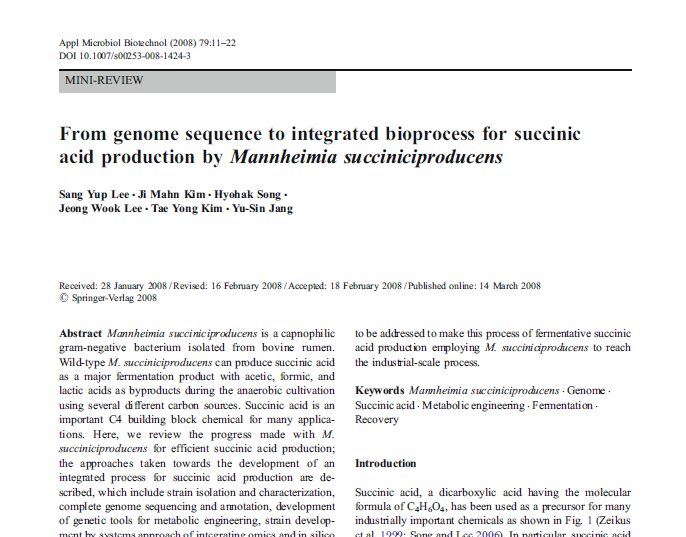
Mannheimia succiniciproducens is a capnophilic gram-negative bacterium isolated from bovine rumen. Wild-type M. succiniciproducens can produce succinic acid as a major fermentation product with acetic, formic, and lactic acids as byproducts during the anaerobic cultivation using several different carbon sources. Succinic acid is an important C4 building block chemical for many applications. Here, we review the progress made with M. succiniciproducens for efficient succinic acid production; the approaches taken towards the development of an integrated process for succinic acid production are described, which include strain isolation and characterization, complete genome sequencing and annotation, development of genetic tools for metabolic engineering, strain development by systems approach of integrating omics and in silico metabolic analysis, and development of fermentation and recovery processes. We also describe our current effort on further improving the performance of M. succiniciproducens and optimizing the mid- and downstream processes. Finally, we finish this mini-review by discussing the issues that need to be addressed to make this process of fermentative succinic acid production employing M. succiniciproducens to reach the industrial-scale process. (Journal citation : Appl. Microbiol. Biotechnol., 79(1): 11-22 (2008))
S.Y. Lee
J.M. Song
Jeong Wook Lee
T.Y. Kim
-
8
Proteome-Level Responses of Escherichia coli to Long-Chain Fatty Acids and Use of Fatty Acid Inducible Promoter in Protein Production (Journal of Biomedicine and Biotechnology , 2008)
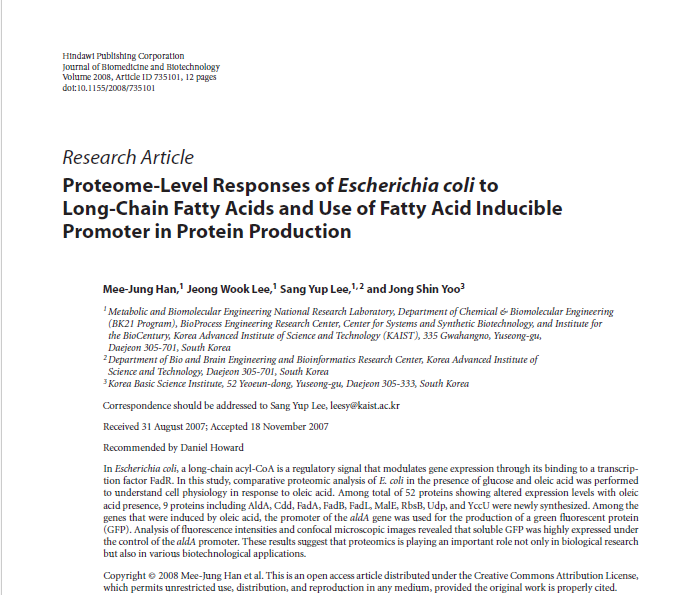
In Escherichia coli, a long-chain acyl-CoA is a regulatory signal that modulates gene expression through its binding to a transcription factor FadR. In this study, comparative proteomic analysis of E. coli in the presence of glucose and oleic acid was performed to understand cell physiology in response to oleic acid. Among total of 52 proteins showing altered expression levels with oleic acid presence, 9 proteins including AldA, Cdd, FadA, FadB, FadL, MalE, RbsB, Udp, and YccU were newly synthesized. Among the genes that were induced by oleic acid, the promoter of the aldA gene was used for the production of a green fluorescent protein (GFP). Analysis of fluorescence intensities and confocal microscopic images revealed that soluble GFP was highly expressed under the control of the aldA promoter. These results suggest that proteomics is playing an important role not only in biological research but also in various biotechnological applications. (Journal citation : J. Biomed. Biotechnol., Article ID 735101, (2008))
M.-J. Han
Jeong Wook Lee
S.Y. Lee
S.Y. Jong
-
7
EcoProDB: the Escherichia coli protein database (Bioinformatics, 2007) (JCR 10%)
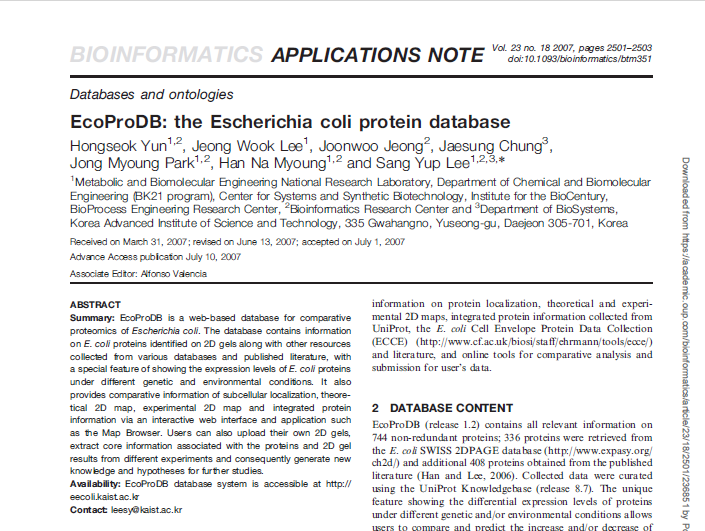
EcoProDB is a web-based database for comparative proteomics of Escherichia coli. The database contains information on E. coli proteins identified on 2D gels along with other resources collected from various databases and published literature, with a special feature of showing the expression levels of E. coli proteins under different genetic and environmental conditions. It also provides comparative information of subcellular localization, theoretical 2D map, experimental 2D map and integrated protein information via an interactive web interface and application such as the Map Browser. Users can also upload their own 2D gels, extract core information associated with the proteins and 2D gel results from different experiments and consequently generate new knowledge and hypotheses for further studies. (Journal citation : Bioinformatics, 23(18): 2501-2503 (2007))
H. Yun
Jeong Wook Lee
J. Jeong
J. Chung
J.M. Park
H.N. Myoung
S.Y. Lee
-
6
Construction and Characterization of Shuttle Vectors for Succinic Acid-Producing Rumen Bacteria (Applied and Environmental Microbiology, 2007)
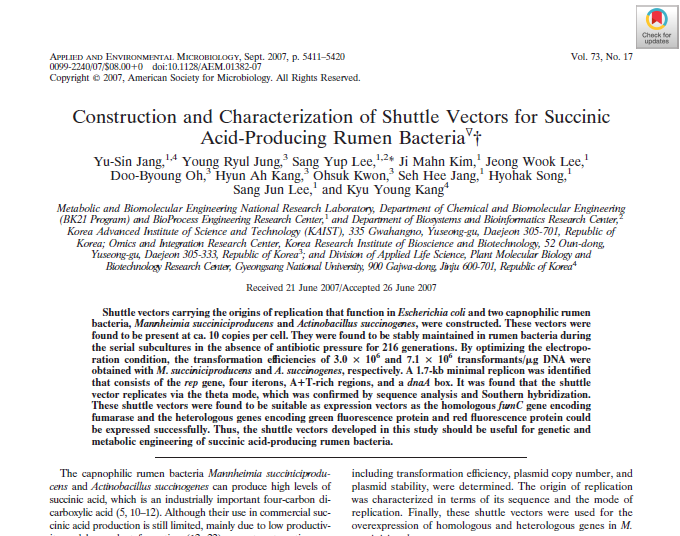
Shuttle vectors carrying the origins of replication that function in Escherichia coli and two capnophilic rumen bacteria, Mannheimia succiniciproducens and Actinobacillus succinogenes, were constructed. These vectors were found to be present at ca. 10 copies per cell. They were found to be stably maintained in rumen bacteria during the serial subcultures in the absence of antibiotic pressure for 216 generations. By optimizing the electroporation condition, the transformation efficiencies of 3.0 × 10⁶ and 7.1 × 10⁶ transformants/μg DNA were obtained with M. succiniciproducens and A. succinogenes, respectively. A 1.7-kb minimal replicon was identified that consists of the rep gene, four iterons, A+T-rich regions, and a dnaA box. It was found that the shuttle vector replicates via the theta mode, which was confirmed by sequence analysis and Southern hybridization. These shuttle vectors were found to be suitable as expression vectors as the homologous fumC gene encoding fumarase and the heterologous genes encoding green fluorescence protein and red fluorescence protein could be expressed successfully. Thus, the shuttle vectors developed in this study should be useful for genetic and metabolic engineering of succinic acid-producing rumen bacteria. (Journal citation : Appl. Environ. Microbiol., 73(17): 5411-5420 (2007))
Y.-S. Jang
Y.R. Jung
S.Y. Lee
J.M. Kim
Jeong Wook Lee
D.-B. Oh
H.A. Kang
O. Kwon
S.H. Jang
H. Song
S.J. Lee
K.Y. Kang
-
5
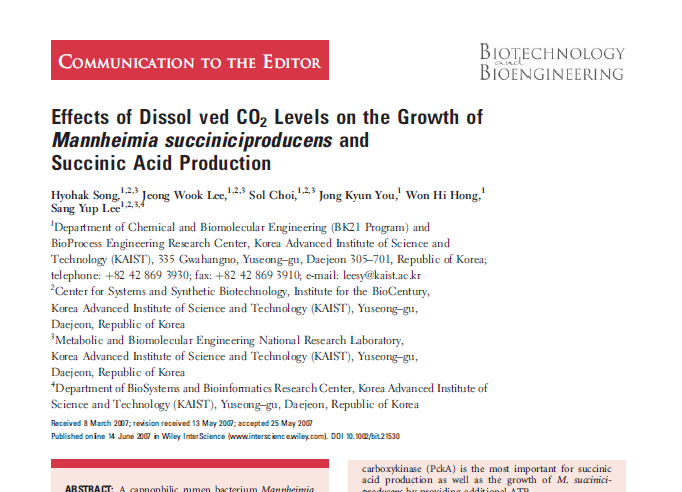
Effects of dissolved CO2 levels on the growth of Mannheimia succiniciproducens and succinic acid production (Biotechnology and Bioengineering, 2007)
A capnophilic rumen bacterium Mannheimia succiniciproducens produces succinic acid as a major fermentation end product under CO2-rich anaerobic condition. Since succinic acid is produced by carboxylation of C3 compounds during the fermentation, intracellular CO2 availability is important for efficient succinic acid formation. Here, we investigated the metabolic responses of M. succiniciproducens to the different dissolved CO2 concentrations (0–260 mM). Cell growth was severely suppressed when the dissolved CO2 concentration was below 8.74 mM. On the other hand, cell growth and succinic acid production increased proportionally as the dissolved CO2 concentration increased from 8.74 to 141 mM. The yields of biomass and succinic acid on glucose obtained at the dissolved CO2 concentration of 141 mM were 1.49 and 1.52 times higher, respectively, than those obtained at the dissolved CO2 concentration of 8.74 mM. It was also found that the additional CO2 source provided in the form of NaHCO3, MgCO3, or CaCO3 had positive effects on cell growth and succinic acid production. However, growth inhibition was observed when excessive bicarbonate salts were added. By the comparison of the activities of key enzymes, it was found that PEP carboxylation by PEP carboxykinase (PckA) is the most important for succinic acid production as well as the growth of M. succiniciproducens by providing additional ATP (Journal citation : Biotechnol. Bioeng., 98(6): 1296-1304 (2007))
H. Song
Jeong Wook Lee
S. Choi
J.K. You
W.H. Hong
S.Y. Lee
-
4
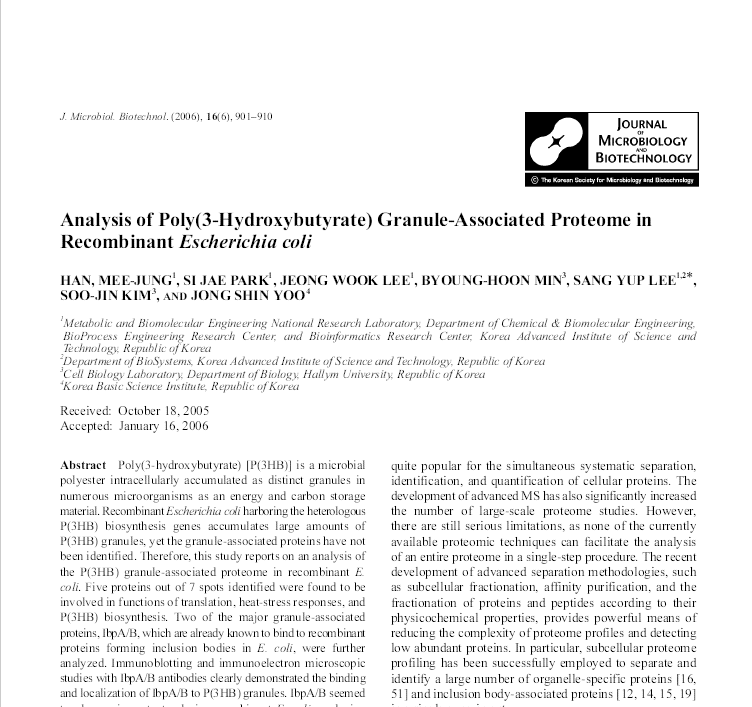
Analysis of poly(3-hydroxybutyrate) granule-associated proteome in recombinant Escherichia coli (Journal of Microbiology and Biotechnology, 2006)
Poly(3-hydroxybutyrate) [P(3HB)] is a microbial polyester intracellularly accumulated as distinct granules in numerous microorganisms as an energy and carbon storage material. Recombinant Escherichia coli harboring the heterologous P(3HB) biosynthesis genes accumulates large amounts of P(3HB) granules, yet the granule-associated proteins have not been identified. Therefore, this study reports on an analysis of the P(3HB) granule-associated proteome in recombinant E. coli. Five proteins out of 7 spots identified were found to be involved in functions of translation, heat-stress responses, and P(3HB) biosynthesis. Two of the major granule-associated proteins, IbpA/B, which are already known to bind to recombinant proteins forming inclusion bodies in E. coli, were further analyzed. Immunoblotting and immunoelectron microscopic studies with IbpA/B antibodies clearly demonstrated the binding and localization of IbpA/B to P(3HB) granules. IbpA/B seemed to play an important role in recombinant E. coli producing P(3HB) by stabilizing the interface between the hydrophobic P(3HB) granules and the hydrophilic cytoplasm. Thus, IbpA/B were found to act like phasins in recombinant E. coli, as they are the major proteins bound to the P(3HB) granules, affect the morphology of the granules, and reduce the amount of cytosolic proteins bound to the P(3HB) granules. (Journal citation : J. Microbiol. Biotechnol., 16(6): 901-910 (2006))
M.-J. Han
S.J. Part
Jeong Wook Lee
B.H. Min
S.Y. Lee
S.-J. Kim
J.-S. Yoo
-
3
The proteome of Mannheimia succiniciproducens, a capnophilic rumen bacterium (Proteomics, 2006)
Mannheimia succiniciproducens MBEL55E isolated from bovine rumen is an industrially important bacterium as an efficient succinic acid producer. Recently, its full genome sequence was determined. In the present study, we analyzed the M. succiniciproducens proteome based on the genome information using 2-DE and MS. We established proteome reference map of M. succiniciproducens by analyzing whole cellular proteins, membrane proteins, and secreted proteins. More than 200 proteins were identified and characterized by MS/MS supported by various bioinformatic tools. The presence of proteins previously annotated as hypothetical proteins or proteins having putative functions were also confirmed. Based on the proteome reference map, cells in the different growth phases were analyzed at the proteome level. Comparative proteome profiling revealed valuable information to understand physiological changes during growth, and subsequently suggested target genes to be manipulated for the strain improvement. (Journal citation : Proteomics, 6: 3550-3566. (2006))
Jeong Wook Lee
S.Y. Lee
H. Song
J.-S. Yoo
-
2
Enhanced Proteome Profiling by Inhibiting Proteolysis with Small Heat Shock Proteins (Journal of Proteome Research, 2005)
Proteolytic degradation is one of the critical problems in two-dimensional electrophoresis (2-DE). Here we report that small heat shock proteins (sHsps), including IbpAEc and IbpBEc from Escherichia coli and Hsp26Sc from Saccharomyces cerevisiae, are able to protect proteins in vitro from proteolytic degradation. Addition of sHsps during 2-DE of human serum or whole cell extracts of E. coli, Mannheimia succinciproducens, Arabidopsis thaliana, and human kidney cells allowed detection of up to 50% more protein spots than those obtainable with currently available protease inhibitors. Therefore, the use of sHsps during 2-DE significantly improves proteome profiling by generally enabling the detection of many more protein spots that could not be seen previously. (Journal citation : J. Proteome Res., 4(6): 2429-2434. (2005))
M.-J. Han
Jeong Wook Lee
S.Y. Lee
-
1
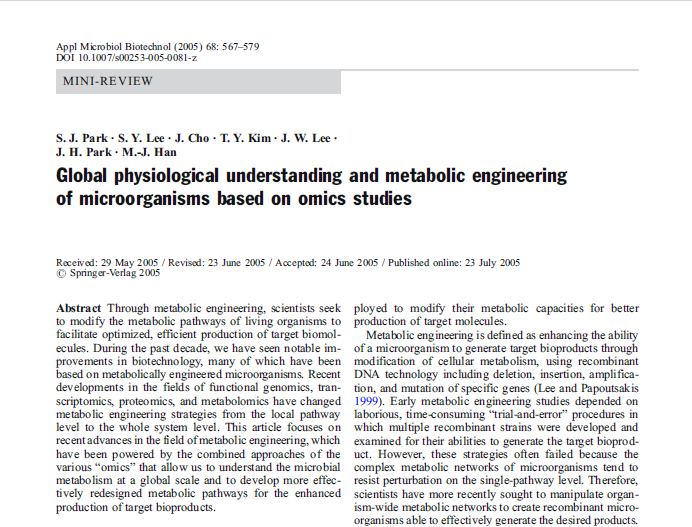
Global physiological understanding and metabolic engineering of microorganisms based on omics studies (Applied Microbiology and Biotechnology, 2005)
Through metabolic engineering, scientists seek to modify the metabolic pathways of living organisms to facilitate optimized, efficient production of target biomolecules. During the past decade, we have seen notable improvements in biotechnology, many of which have been based on metabolically engineered microorganisms. Recent developments in the fields of functional genomics, transcriptomics, proteomics, and metabolomics have changed metabolic engineering strategies from the local pathway level to the whole system level. This article focuses on recent advances in the field of metabolic engineering, which have been powered by the combined approaches of the various “omics” that allow us to understand the microbial metabolism at a global scale and to develop more effectively redesigned metabolic pathways for the enhanced production of target bioproducts. (Journal citation : Appl. Microbiol. Biotechnol., 68:567-579. (2005))
S.J. Park
S.Y. Lee
J. Cho
T.Y. Kim
Jeong Wook Lee
J.H. Park
M.-J. Han